



Dipendra Dhakal
+977-9851093471 (Whatsapp)Nar Phu Valley Trek – 11 Days
13 reviews in Tripadvisor


Duration
11 Days
Group Size
2-15
Difficulty
Moderate
Max. Altitude
5,320m. / 17,454ft.
Meals
Breakfast, Lunch, Dinner
Activities
Trekking & Sightseeing Price starts
US$ 1800
We offer group discounts
- 1 over 9999 US$ 1800
Total Cost:
US$ 1800
Need Help? Ask Questions 

Introduction of Nar Phu Valley Trek – 11 Days
Nar Phu Valley Trek takes us on an 11-day trek to the hidden Nar and Phu villages. From this trek, you’ll get to explore the untouched valleys in Nepal, far from the hustle and bustle of the city.
Begin this Nar Phu Valley Trek with a long drive to the headquarters of the Lamjung district, Besisahar. Keep on the drive through the Prithvi Highway past the villages of Bhulbhule, Tal, Dharapani, Timang, and Thanchok to arrive at the village of Koto. The next day, our trek sees us walking along the Soti Khola via the rhododendron and pine forest to make it to Dharamsala. From there, an easy hike will see us at the Meta Village.
On our fourth day, we’ll officially enter the Nar and Phu valleys with our entry to the Phu village. During our hike today, we’ll come across three ancient forts. While at Phu, explore the Tahsi Lakhang Monastery and enjoy the beautiful views of the Manaslu and Himlung peaks. Descend back to Meta village before making our way up to the Nar Phedi. Ascend to the hidden valley of Nar.
The Nar village offers extraordinary views of the Annapurna and Pisang peaks. While here, we might also see the nearly extinct bearded vulture, Lammergeier. The next day, we’ll hike through yak pastures to get to Kang La Phedi, and from there, it’s a steep ascent to Kang La Pass. While at the top, enjoy landscape views of the Annapurna, Pisang, Tilicho, Gangapurna, and Dhaulagiri peaks. Hike downhill to Ngawal and Pisang before returning to Besisahar and off to Kathmandu.
This trail is a moderately difficult trek on the off-beaten Trails. This Nar Phu Valley Trek is one of the most popular hidden valley treks in Nepal, even more than the Khopra Danda Trek or the Tsum Valley Trek.
Email our trip experts if you need to modify this trail for the best experience in the Everest Region. Simply email us at info@www.adventurewalkway.com.
What To Expect On The Nar Phu Valley Trek?
Nar Phu Valley Trek is a scenic and tranquil trekking experience. Walking through the off-the-beaten path of the Annapurna region is thrilling and adventurous. The route was opened in 2003 and remains one of the less crowded trekking routes. Trekkers will get an opportunity to trek through the forests of rhododendron to alpine meadows.
Similarly, it also provides panoramic views of mountains like Annapurna, Gangapurna, Himlung, Manaslu, and other surrounding peaks. Since the route goes through the Annapurna Conservation Area, you can witness diverse flora and fauna during the trek. You can get the opportunity to encounter wildlife like Himalayan tahr, blue sheep, and numerous bird species.
There is a strong influence of Tibetan culture in Nar Phu Valley. The local ethnic groups living in the region are referred to as Narphuwal or Narphu people. They have their unique culture, traditions, and languages. Trekkers can witness traditional houses with Tibetan architecture decorated with intricate woodwork and carvings. Likewise, you can witness ancient monasteries, gompas, and stupas along the trek route.
Nar Phu Valley Trek is an excellent way of experiencing the region’s culture, traditions, local customs, and local cuisines. The locals of the region often wear their traditional clothing. So, you can get a glimpse of their traditional clothing, intricate jewelry, unique headgear, handicrafts, and more. You can also buy the local handicrafts as souvenirs.
Nar Phu Valley Trek is a blend of nature and cultural experience. Since it is a less-commercialized trek destination, trekkers can experience the untouched nature and local culture. It is undoubtedly one of the hidden gems of the Annapurna region.
Additional Information
There are four seasons in Nepal, i.e., spring, summer, autumn, and winter. The spring (March to May) and autumn (September to November) are considered the best times for the Nar Phu Valley Trek. The summer season (June to August) coincides with the monsoon, and the winter season (December to February) brings heavy snowfall at higher elevations.
Spring is the pre-monsoon season in Nepal. The weather is warm and pleasant. Moreover, it is the season of flowers, so trekkers can get some of the most beautiful scenery in the region. The landscapes are vibrant and colorful as the forests of rhododendrons are in full bloom. There is occasional rainfall, but the sky is clear. You can get stunning mountain views of Annapurna, Gangapurna, Tilicho, Dhaulagiri, and many more.
The summer season brings rainfall, which makes the trail in the lower region of Nar Phu Valley muddy and slippery. There is also the danger of landslides. The higher region of the Nar Phu Valley is relatively dry. But trekking to the region during the summer is not recommended.
The autumn season is also festive in Nepal. Because it is a post-monsoon season, the rain washes away most of the dust and pollution. Therefore, you can enjoy the views and scenery the best during autumn. The climate and temperature are the most favorable. Furthermore, the weather is crisp with clear skies. During late autumn, the temperature slowly starts to get colder.
Winter is another unfavorable time for the Nar Phu Valley Trek. The region is covered with thick layers of snow. It makes trekking to Nar Phu challenging. The trail also becomes slippery. The temperature can get significantly low. The accommodations along the Nar Phu Valley route may close or reduce services during winter. The visibility is also limited due to snowfall. Moreover, there is a risk of avalanches. Overall, trekking to Nar Phu Valley during winter is not recommended.
Highlights of Nar Phu Valley Trek – 11 Days
- Experience the lifestyle of rural and explore off the beaten path of Nar Phu Valley.
- Walk up to the Kang La Pass at 5320 meters altitude.
- Get stunning mountain views of Annapurna, Gangapurna, Tilicho, Dhaulagiri, and several other peaks.
- Diverse and unique trail filled with wildlife and flora.
- Trek by ancient monasteries, gompas, and stupas.
- Experience the unique culture, tradition, and local customs of Nar Phu Valley.
Itinerary of Nar Phu Valley Trek – 11 Days
Once you arrive at the Tribhuvan International Airport, make your way to your hotel to freshen up. Meet with your reps to plan further about the upcoming trek. Once the meeting is over, the company guide will tell you about the things you can do in Kathmandu during your free time.

Max. Altitude: 1310m./4,298ft. (Kathmandu)

Meal: Breakfast

Accommodation: Hotel
Today we prepare for the trek and check the last-minute checklist for trekking gears and if needed shopping around Themel. After lunch visit Kathmandu UNESCO world heritage sites, Kathmandu Durbar Squire, Pashupatinath Temple, and Bouddhanath Stupa. Overnight at Hotel.

Activity: Sightseeing
Max. Altitude: 1310m./4,298ft. (Kathmandu)
Meal: Breakfast, Lunch, Dinner
Accommodation: Hotel
Start off with a long drive through the Prithvi Highway to the headquarter of Lamjung district, Besisahar. From there, we’ll drive past the villages of Bhulbhule, Tal, Dharapani, Timang, and Thanchok to get to the village of Koto. Enjoy the ride as you’ll get to see some natural wonders along the way.
Max. Altitude: 2600m./8,530ft. (Koto)
Meal: Breakfast, Lunch, Dinner
Accommodation: Hotel
Today, we’ll hike along the Soti Khola via rhododendron and pine forest to first arrive at Dharamsala. After lunch, our trek will continue through forests uphill to get to the Meta village. With this, we’ve entered the Nar and Phu valley. Enjoy the views of the Annapurna and Lamjung peaks along the trail.
Max. Altitude: 3570m./11,713ft. (Meta)
Meal: Breakfast, Lunch, Dinner
Accommodation: Hotel
Hike uphill along the forested trail to get to the Phu Valley. Prior to getting to Phu, we’ll come across three ancient forts, one of which is still standing while the other two are nothing but rubble. Explore the Tashi Lakhang Gompa, which is dedicated to Lama Karma Sonam Rinpoche. This monastery is also taken as one of the 108 greatest Buddhist monasteries. Get breathtaking views of the Manaslu and Himlung during our trek.
Activity: Trek
Max. Altitude: 4050m./13,287ft. (Phu )
Meal: Breakfast, Lunch, Dinner
Accommodation: Tea house
An easy trek ends the day! Hike downhill back to Meta but, find an intersection in-between to Nar Phedi. During your free time here, explore the Nar Phedi monastery.
Activity: trek
Max. Altitude: 3490m./11,450ft. (Nar Phedi)
Meal: Breakfast, Lunch, Dinner
Accommodation: Tea house
Leave Nar Phedi and Lapche rivers behind to hike uphill to get to the hidden valley of Nar, which sits at the foothill of Pisang Peak (6091m). During your time here at Nar, explore the old Buddhist monasteries and mani walls.
If we’re lucky, we’ll get to see the nearly extinct Lammergeier (bearded vulture). Enjoy the sunset over the Annapurna, Dhaulagiri, Pisang, Himlung, and Kanguru peaks.
Activity: Trek
Max. Altitude: 4120m./13,517ft. ( Nar)
Meal: Breakfast, Lunch, Dinner
Accommodation: Tea House
Start off the day with an early trek through yak pastures to get to Kang La Phedi. From there, ascent on a steep trail to arrive at Kang La Pass, which sits at a height of 5320 meters. While here, enjoy the landscape views of the Annapurna, Pisang, Tilicho, Gangapurna, and Dhaulagiri peaks. Hike downhill to get to Ngawal for an overnight stay.
Activity: Trek
Max. Altitude: 5320m./17,454ft. (Ngawal)
Meal: Breakfast, Lunch, Dinner
Accommodation: Tea House
An easy hike downhill will take us to the village of Pisang. From there, it’s a short drive back to the village of Besisahar.
Activity: Trek
Meal: Breakfast, Lunch, Dinner
Accommodation: Tea House
Get back on the road on a long drive to Kathmandu. The drive will take around 5-6 hours. Freshen up and roam around the city during your free time.
Max. Altitude: 1310m./4,298ft. (Kathmandu )
Meal: Breakfast, Lunch, Dinner
Accommodation: Hotel
11 days of our traveling journey come to an end today. Depart to your hometown or off to your next destination
Max. Altitude: 1310m./4,298ft. (Kathmandu)
Meal: Breakfast
Accommodation: Hotel
Includes/Excludes
What is included?
- Pick-up & Drop from the airport on the day of your arrival & Departure
- 3 Night Tourist Standard Hotel in Kathmandu
- The Government Register’s English-Speaking Guide
- If the group size exceeds 6 people, an assistance guide will be provided.
- One porter for two clients
- In trekking trails, accommodation is on a twin-sharing basis
- Breakfast, Lunch, and Dinner are included.
- Trekking map
- Trekking Permit & TIMS Card
- Transportation as per itinerary
- Staff salaries, insurance, meals, accommodations, equipment, transportation, etc.
- Arrangements for emergency rescue services (Please make sure you have medical insurance from your country)
The agency service charge and the government tax/VAT
The certificate of achievement towards the Trip
What is excluded?
- The cost of international airfare
- Visa fees for Nepal
- All drinks During the Trip (Tea, Coffee, Cola, Beer, Mineral Water)
- Personal Costs
- Smoke
- Insurance for travel
- If more than the 3-night hotel in Kathmandu
- Kathmandu meals
- Hot shower during the trekking
- Batteries and cameras that are chargeable during the trek
- Natural or political disturbances beyond our control result in additional costs.
- The Extra cost of any case early return from the trip.
Tips for Trekking Staff
Route Map of Nar Phu Valley Trek – 11 Days
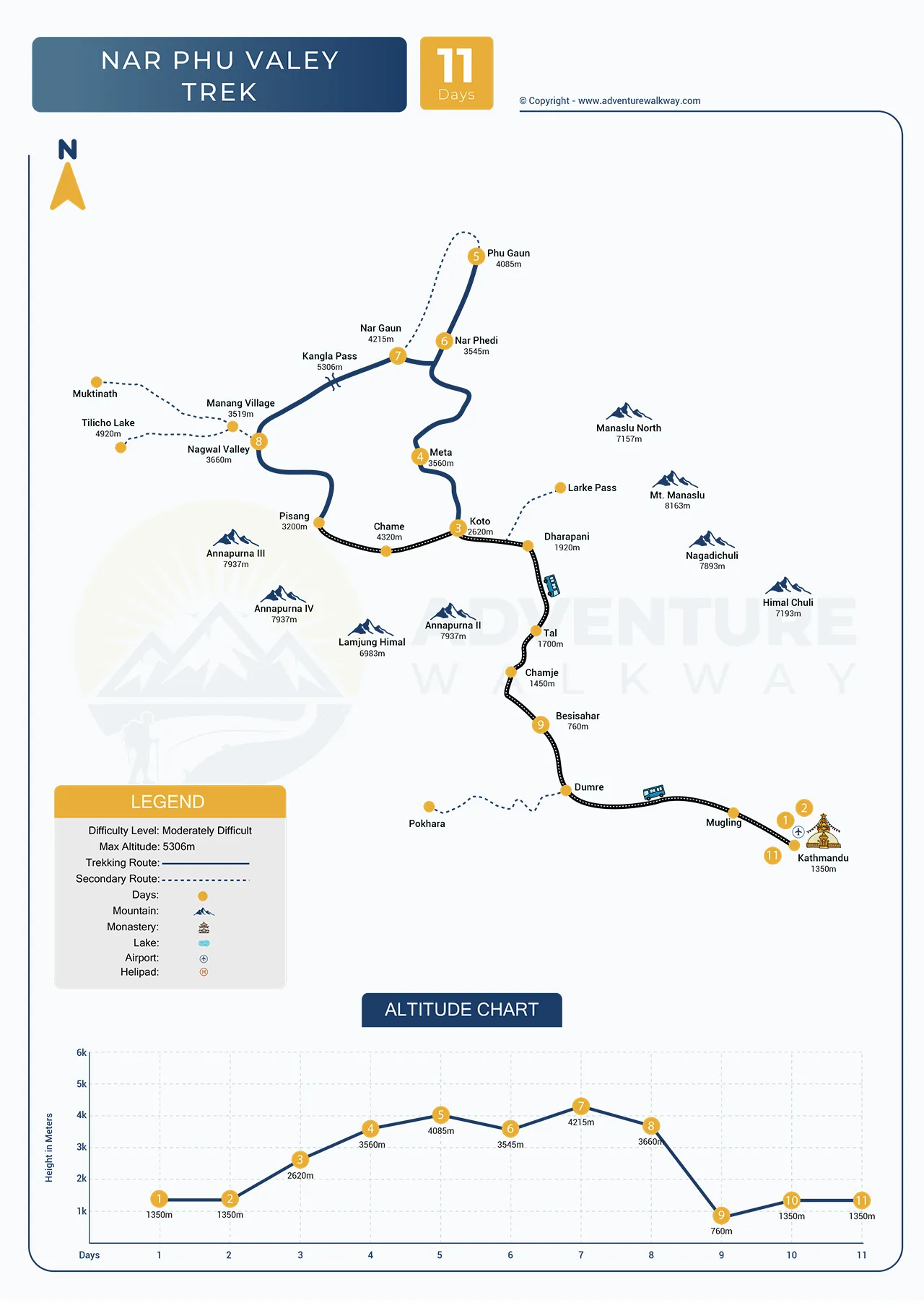
Trip Information
Best Time
The ideal times to go on the Nar Phu Valley Trek are spring (March to May) or autumn (September to November). In spring, it is warm and sunny during the day, typically with blue skies, and rhododendron flowers cover the hills. It is a clean, full-of-life environment.
Autumn is also beautiful, with cool, settled weather and excellent mountain views everywhere. The air is generally crystal clear, and the trek is just perfect—neither hot nor cold. Such seasons render the trek comfortable, safe, and magical.
Summer (June to August) is the time of the monsoon. The region gets less rain than other parts of Nepal, but there can still be cloudy weather, muddy trails, and slower travel. It is quieter and more verdant, although you need to take care of it.
Winter (December to February) is the season for snow and freezing temperatures, especially at higher altitudes. The trail is deserted, and the landscape is stunning with snow, but high passes like Kang La can be difficult or impossible to negotiate.
For clear weather, good visibility, and a safe trail, spring and autumn are the best seasons to visit Nar Phu Valley.
Elevation and Distance
The highest point of the Nar Phu Valley Trek is Kang La Pass, which is 5,320 meters (17,454 ft.) high. Although it’s a tough climb, the mountain views from the top are breathtaking. The lowest point is Kathmandu at 1,310 meters (4,298 ft), where your trek begins and ends.
During the trek, you’ll walk through quiet villages, forests, rocky trails, and open mountain valleys. The total walking distance is around 65 to 70 kilometers. It might sound like a lot, but it’s spread out over several days, with plenty of time to rest and enjoy the views.
This trek is a beautiful mix of nature and culture. You’ll get to meet local people, visit old monasteries, and see a different side of Nepal that not many travelers explore. The climb to Kang La Pass is the most challenging part, so staying fit and going slow will help a lot.
Difficulty and Altitude Sickness
The Nar Phu Valley Trek is a moderate to challenging trek, mainly because of its high altitude and steep trails. You don’t have to be a seasoned trekker, but you must be quite fit and ready for long walks. Some days are more challenging than others, especially the day you cross Kang La Pass at 5,320 meters, which is the highest point of the trek.
Because of the altitude, there is a risk of also getting altitude sickness, especially when you are going up. You will feel tired, get a headache, or feel dizzy. It is best to walk slowly, drink plenty of water, and rest whenever possible. The trek is designed to acclimatize your body to the altitude, but it is always sensible to take heed of your body.
With the right mindset and some preparation, most people can enjoy this off-the-beaten-path trek safely and happily.
Maximum and minimum walks per day
During the Nar Phu Valley Trek, the walking time varies from 3 to 8 hours a day. On average, you’ll be walking around 5 to 6 hours daily, depending on the trail and altitude.
Day 8 is the toughest day of walking when you trek over Kang La Pass (5,320m) and drop down to Ngawal. It’s the toughest day with around 8 hours walking—a morning steep uphill and an afternoon long downhill. It’s a challenging day, but the most rewarding day with stunning scenery
The shortest walking day is Day 6, from Phu to Nar Phedi, a 3 to 4-hour walk on an easier, downward-sloping trail.
The other days are generally 5 to 6 hours of walking along villages, valleys, and forests. The trek gives you a good mix of tough climbs and easy parts so that your body gets acclimatized, while the trek doesn’t get boring.
Accommodation
During the Nar Phu Valley Trek, you’ll spend 3 nights in a tourist-standard hotel in Kathmandu. These hotels are comfortable, clean, and great for relaxing before and after the trek.
Along the trekking trail, the lodging is usually at village lodges or teahouses and is on a twin-sharing basis. The rooms are simple but comfortable, with good beds, pillows, and warm blankets to keep you snug through the chilly nights. Most of the rooms offer great mountain or valley views, making waking up even more magical.
The bathrooms are usually communal and fitted with Eastern-style toilets. Nothing luxurious, but clean and well-maintained. Most of the lodges also have a heated dining hall where you can eat, socialize with other trekkers, and warm yourself by the fire in the evenings.
The lodging is simple but comfortable, friendly, and perfect for the mountain experience.
Food and Drink
In the Nar Phu Valley Trek, breakfast, lunch, and dinner are provided every day as part of your package. You will normally have meals at teahouses, and the food is simple but hearty with rice, noodles, soups, potatoes, bread, and Dal Bhat, a staple Nepali food made of rice, lentils, and vegetables. Not only is it filling, but it is also warm and gives you the energy you require for trekking.
Drinks like tea, coffee, and bottled water are offered, but anything beyond the meals covered, like snacks or extra drinks, must be bought at your own expense. Bringing some extra cash for that is a good idea.
To remain healthy and safe, it’s best to refrain from meat, as it’s difficult to keep fresh in the high mountain regions. Avoid alcohol and other intoxicating drinks as well, particularly at high altitudes, as they can further lead to altitude sickness. Opt for warm beverages and light, healthy meals to feel your best.
Alternative Routes
If you search for other Nar Phu Valley Trek itineraries, there are a few that are designed according to different interests and time limitations:
Nar Phu Valley Trek—10 Days: A 10-day variant that is designed for time-constrained trekkers. It provides the same traditional highlights, including Nar and Phu villages and Kang La Pass crossing, in a shorter time and without compromising on the essence.
Annapurna Circuit with Nar Phu Valley Trek—16 Days: This longer trek combines the off-the-beaten-path Nar Phu Valley with the Annapurna Circuit classic. After exploring Nar and Phu, trekkers meet the Annapurna trail, traverse Thorong La Pass, and then visit pilgrimage spots like Muktinath.
Manaslu and Nar Phu Trek—19 Days: A combination trip for the adventurous of Manaslu Circuit and Nar Phu Valley, it involves the crossing of high passes like Larkya La and Kang La, and diverse landscape and culture.
Nar Phu and Upper Mustang Trek through Teri La Pass—22 Days: This challenging trek links Nar Phu Valley with the sacred Upper Mustang area through the Teri La Pass. It’s ideal for experienced trekkers who want off-the-beaten-path trails and special cultural experiences.
All of these treks provide a distinctive view of Nepal’s varied landscape and cultures. The choice is yours, based on your time constraints, your physical condition, and your wish to see various regions.
Can a beginner join this trek?
Yes, a beginner can attempt the Nar Phu Valley Trek, but one has to be well-prepared. The trek is of moderate to challenging grade, mainly because of the altitude and some stony and steep paths. You don’t need to be an experienced trekker, but be physically sound and ready to walk for 5–7 hours each day.
Before the trek, it’s a good idea to do regular walks, stair climbing, or light hikes to build your stamina. Since you’ll be going above 5,000 meters, it’s also important to walk slowly, stay hydrated, and rest when needed to avoid altitude sickness.
A guide is always present to help you, and there are enough acclimatization days in the itinerary to help your body get used to it. Mindset, preparation, and assistance—everything being proper—even inexperienced trekkers can undergo the Nar Phu Valley Trek and complete it successfully. It’s a perfect adventure for an individual seeking a challenge.
Preparation and Fitness
To have a good time on the Nar Phu Valley Trek, proper preparation and general fitness are essential. You don’t have to be an athlete, but you must be able to walk for 5 to 7 hours a day, usually on steep and uneven terrain. Begin training at least a month before the trek with regular walking, jogging, or climbing stairs. Emphasize developing leg strength, stamina, and endurance.
Carry a light backpack on practice hikes to acclimatize your body to the experience of trekking. Do not forget mental preparation, as high-altitude treks are tiring, and a good attitude is half the trick.
Also, prepare by breaking in your trekking boots, packing warm clothes, and making sure you have everything you need. The better prepared you are, the safer and more enjoyable the trek is going to be. Being in good shape and well-prepared will allow you to fully enjoy the scenery of Nar Phu Valley.
Gadget charging, Internet, and communication
On the Nar Phu Valley Trek, it’s not easy to remain connected and keep your gadgets charged due to the remoteness of the area. Here’s what you need to know:
Lower-altitude settlements like Koto and Ngawal generally have electricity in teahouses, typically produced by solar panels or small generators. But the higher you go, electricity is a rarity. You can recharge your devices in some teahouses, usually in common areas, at an extra fee of NPR 300 to 500 per hour.
It is best to carry a high-capacity power bank or a solar charger to recharge your devices along the trek.
Cell phone reception in the Nar Phu Valley is limited and cannot be relied upon. While there may be occasional NTC or Ncell signals in some of the lower-altitude areas, the higher regions are typically not connected.
Some of the teahouses may offer Wi-Fi for a fee, but the signal is very weak and cannot accommodate heavy internet use. It is better to inform family and friends of the anticipated communications blackout before heading out on the trek.
While there are some facilities, one must be ready for limited access to electricity and communications along the trail.
Permit
For the Nar Phu Valley Trek, you’ll need a few important permits to enter the restricted and protected areas. First, there’s the Nar Phu Valley Restricted Area (NRA) Permit, which is required because this region is not open to free individual trekkers and has special regulations.
Next, you’ll need the Annapurna Conservation Area Project (ACAP) Permit, since a large part of the trek falls within the Annapurna Conservation Area, which helps protect the environment and support local communities.
Lastly, the Trekking Information Management System (TIMS) Permit is necessary to ensure your safety and keep track of trekking activities in the region.
Don’t worry about the paperwork—let all the permits be ours. They are already included in your trekking package, so you won’t have to go through anything else. You can just sit back and relax, and enjoy the trek and the breathtaking mountain views.
Transportation
Transportation is needed at the beginning and end of the Nar Phu Valley Trek. First, we’ll drive from Kathmandu to Koto via Besisahar, which is the starting point of the trek. After finishing the trek, we’ll drive from Pisang to Besisahar and then back to Kathmandu.
We organize all the transfers in comfortable, well-maintained vehicles depending on the number of individuals. For small numbers, we provide private cars or jeeps, and for a large number of individuals, it will be transferred in a well-conditioned van, Hiace, or tourist bus. They are all big and clean, so that you have a smooth ride through the turns of the mountains.
Our drivers are experienced and careful; thus, the long drives can become immensely relaxing. Road trips with country roads shall enjoy scenic surroundings, including rivers, villages, and forest cover, as they travel through, giving you great to and froms for trekking. Feel relaxed and watch with no complications.
Insurance
For the Nar Phu Valley Trek, we highly recommend taking travel insurance due to the high altitude and secluded nature of the trek. The trek reaches up to 5,320 meters (17,454 feet), where medical facilities are limited. Taking out complete insurance prepares you for any urgency that may arise during trekking.
Your insurance should include some very critical things. First, it should cover emergency medical expenses, which would look after any medical care for injury or illness during the trek.
Second, since the trek is at high altitude, your insurance should also cover emergency evacuation and helicopter rescue. This is necessary in case of severe altitude sickness or any accident that requires immediate evacuation.
Also, your policy should include trip cancellation or interruption. This compensates you if you are compelled to cancel or truncate your trip due to unforeseen circumstances. Lastly, repatriation cover is essential, which covers the cost of getting you returned to your home country if need be.
Make sure the policy you buy covers activities up to 5,320 meters and includes provisions for emergency evacuation.
What to Expect
On the Nar Phu Valley Trek, you will experience an adventurous and stimulating trek with breathtaking natural beauty. The trekking trail goes through remote villages, ancient monasteries, and rugged trails, with stunning views of great peaks like Annapurna, Pisang, and Himlung. The trek exposes you to the unique culture of the Nar and Phu valleys, where you observe traditional Tibetan village life and locals leading a simple, religious existence.
The landscape changes dramatically as you ascend, from rainforests to high-altitude desert terrain, broken by picturesque meadows and yak grazing areas along the way. You will be challenged by ascending to high altitude, with the choice of challenging your endurance, especially when traversing the Kang La Pass at 5,320 meters.
While the trek can be arduous, it is an experience well worth the trouble. There is a definite sense of achievement as you relax within one of Nepal’s most isolated and untainted regions.
Frequently Asked Questions
The Nar Phu Valley Trek takes you into the remote areas of the Annapurna Region. Despite it being a less-traveled destination, the Nar Phu Valley Trek is safe for trekkers. However, choose the right time for trekking and prepare proper equipment. During the rainy season and mid-winter, the trail can become unsafe due to heavy rainfall and snowfall.
The Nar Phu Valley Trek is moderately difficult and requires basic fitness for trekkers. The trail conditions at higher elevations can get rugged and rocky. Similarly, trekkers have to be prepared to walk 5 to 6 hours on average during the trek. You have to be prepared to ascend and descend on varied terrains as well as cross several rivers on suspension bridges.
The Nar Phu Valley has been classified as a restricted area by the government of Nepal. Therefore, you need to get a restricted permit for the trek. Similarly, you are also required to take the TIMS (Trekkers Information Management System) card and ACAP (Annapurna Conservation Area Permit).
The Kang La Pass is a high mountain pass that is also the highest point of the Nar Phu Valley Trek. It sits at an elevation of 5,322 meters and is located in the Manag District. Similarly, it lies between the Nar Valley to the east and Upper Manag Valley to the west.
There are tea houses and lodges available for accommodations along the Nar Phu Valley trail. These accommodations provide basic facilities and usually have shared rooms, bathrooms, and communal dining spaces. These tea houses and lodges provide beds, blankets, and simple meals. The amenities are also limited. So, do not expect to find luxury accommodations during the Nar Phu Valley Trek.
Trip Reviews
Price starts
US$ 1800
We offer group discounts
- 1 over 9999 US$ 1800
Total Cost:
US$ 1800
Need Help? Ask Questions
Dipendra Dhakal
+977-9851093471 (Whatsapp)