



Dipendra Dhakal
+977-9851093471 (Whatsapp)8 Days Everest View Trek
13 reviews in Tripadvisor



Duration
8 Days
Group Size
1-16
Difficulty
Easy
Max. Altitude
3,450m. / 11,319ft.
Meals
Breakfast, Lunch, Dinner
Accommodation
Hotel
Activities
Trekking Price starts
US$ 760
We offer group discounts
- 1 - 1 personUS$ 860
- 2 - 5 personUS$ 760
- 6 over 9999 US$ 660
Total Cost:
US$ 860
Need Help? Ask Questions 

Introduction of 8 Days Everest View Trek
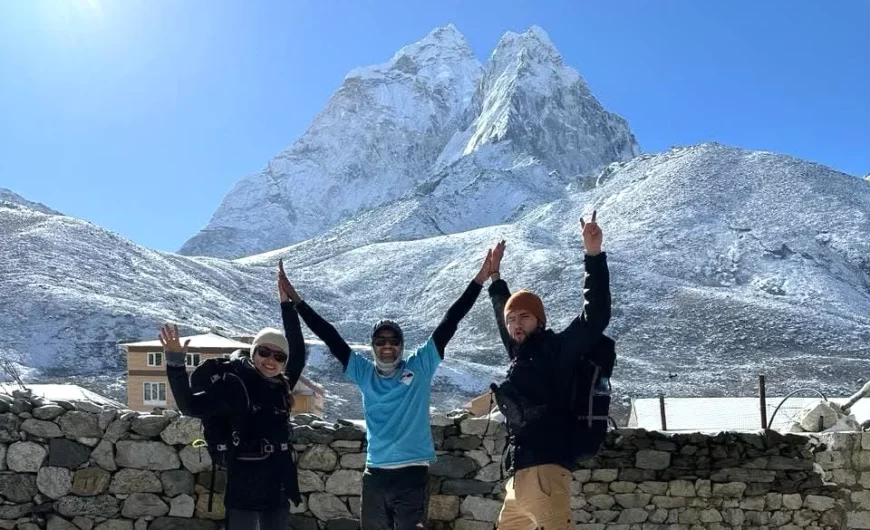
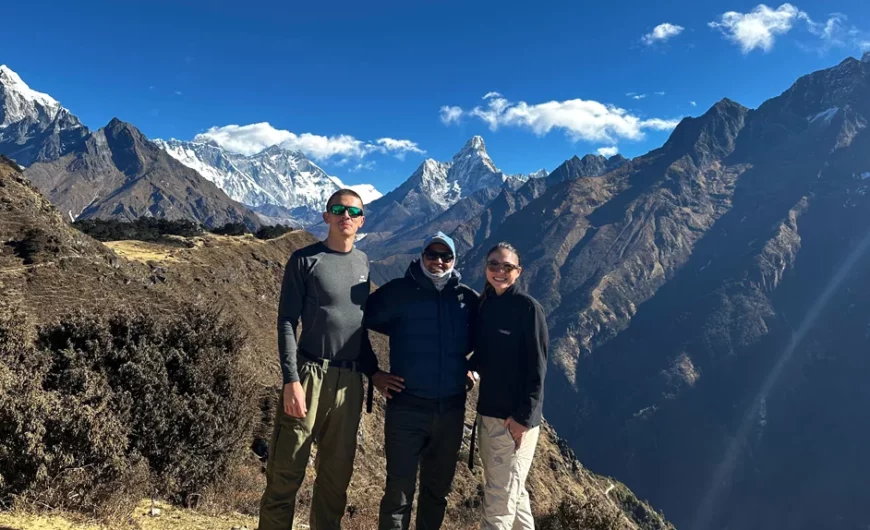
Explore the Everest Region via a bird’s eye view from one of the highest hotels in the world on this 8-day Everest View Trek. Cherish the panoramic views of the Mahalangur Mountain Range, including Everest and Ama Dablam, and get in touch with the Tibetan-influenced Sherpa culture and tradition of the region.
This journey to Hotel Everest View via Sagarmatha National Park and the tourist hub of the Khumbu Region, Namche Bazaar, starts with a 30-minute flight to the Tenzing and Hilary Airport at Lukla. The airstrip is considered one of the most adventurous airstrips in the world.
After meeting with the crew at Lukla, the trekking tour finally sets off. First, our trail takes us to the village of Phakding, which lies on the banks of the Dudh Koshi River. From Phakding, we first get to Monjo, from where we enter the UNESCO-listed world heritage site, Sagarmatha National Park. Up and about, and we get to Namche Bazaar. We should’ve taken a day off to acclimatize to the climate if it was any other Everest Region trekking tour. But, since we won’t be getting much higher, taking a day off isn’t necessary for us.
After breakfast in Namche, our trail hiked up to the nearby village of Syangboche. This village is our final destination for this tour. Syanboche is home to the former highest hotel in the world, Hotel Everest View and an airstrip is typically constructed for the hotel, the Syanboche airstrip. Enjoy the views of Everest, Nuptse, Lhotse, Thamserku, Kusum Kanguru, Tawache, Khumbila, and the most beautiful mountain in the region, Amadablam.
This trail is easier than that of the typical Everest Base Camp treks but the experience is still out of this world.
Email our trip experts in case you need to modify this trail for the best experience in the Everest Region. Simply email us at info@www.adventurewalkway.com
Highlights of 8 Days Everest View Trek
- Journey to the Base Camp of worlds Highest Mountain.
- Follow the Footprint of Legendary Mountaineers.
- Learn the culture and Tradition of Sherpa and their Lifestyle.
- One of the Best route with cascades, Suspension Bridge, Small villages and Majestic Mountains.
- Diverse Sagarmatha National Park.
- Khumbu Glacier and Best Everest View Point (Kalapatthar).
Itinerary of 8 Days Everest View Trek
Land in Kathmandu, Nepal, where you’ll get settled in your hotel to freshen up and meet with your rep, who will brief you about the upcoming trek to Everest. By the available time, the company guide will offer you suggestions of the places to visit and the things to do. Overnight in Kathmandu.

Max. Altitude: 1350m./4,429ft. (Kathmandu)
Today we prepare for the trek and check the last-minute checklist for trekking gear and if needed shopping around Thamel. After lunch visit Kathmandu UNESCO World Heritage sites, Kathmandu Durbar Squire, Pashupatinath Temple, and Bouddhanath Stupa.
Max. Altitude: 1350m./4,429ft. (Kathmandu)

Accommodation: Hotel
This morning, we’ll be taking a short 32-minute scenic flight to Lukla, where the airport is named after the first summiteers of Everest. You’ll meet with your crew and make your way to Phakding. Get past the villages of Chaurikharka and Cheplung before going down towards the Dudh Koshi. An easy walk along the river banks will take us to Phakding.
Max. Altitude: 2610m./8,563ft. (Phakding)
After their morning breakfast, we’ll head out to Monjo and then to Namche Bazaar. We’ll first cross the Dudh Koshi on a suspension bridge to get to Toktok and then to Benkar with a short trek.
Keep on your trek to get to Monjo, the entry point to the Sagarmatha National Park. From here, it’s an easy trek to Jorsalle and an uphill climb to Namche Bazaar. Namche is the tourist hub of the Khumbu Region.
Max. Altitude: 3440m./11,286ft. (Namche)
Accommodation: hotel
Be prepared for a marvelous day ahead filled with stunning views of the Mahalangur Mountain Range. Start early with a trip to Syangboche which basically contains a semi-abandoned airstrip, constructed in 1971. The airstrip was basically established to serve Hotel Everest View, the then-highest hotel in the world.
From here, we make our way up to Hotel Everest View to get panoramic views of Everest, Nuptse, Lhotse, Thamserku, Kusum Kanguru, Tawache, Khumbila, and the most beautiful mountain in the region, Amadablam. Back to Namche for an overnight stay.
Max. Altitude: 3440m./11,286ft. (Namche)
Following breakfast, we’ll start our trip back to Lukla. Hike downhill to get to Jorsalle and then to Monjo. Exit Sagarmatha National Park and get past the villages of Benkar, Toktok, and Phakding to finally get to Lukla.
A short 32-minute flight in the morning will take us back to Kathmandu. After breakfast, you can either take the whole day off or check out some of the UNESCO-listed world heritage sites in the Kathmandu Valley.

Activity: 30min
Max. Altitude: 1350m./4,429ft. (Kathmandu)
After 7 busy days exploring the Khumbu Region through the Everest View Trek, it’s time to head home or to your next destination.
Includes/Excludes
What is included?
- Pick-up & Drop from the airport on the day of your arrival & Departure
- 3 Night Tourist Standard Hotel in Kathmandu
- Lukla Round Flight Ticket
- The Government Register’s English-Speaking Guide
- If the group size exceeds 6 people, an assistance guide will be provided.
- One porter for two clients
- In trekking trails, accommodation is on a twin-sharing basis
- Breakfast, Lunch, and Dinner are included.
- Trekking map
- Trekking Permit & TIMS Card
- Transportation as per itinerary
- Staff salaries, insurance, meals, accommodations, equipment, transportation, etc.
- Arrangements for emergency rescue services (Please make sure you have medical insurance from your country)
- The agency service charge and the government tax/VAT
- The certificate of achievement towards the Trip
What is excluded?
- The cost of international airfare
- Visa fees for Nepal
- All drinks During the Trip (Tea, Coffee, Cola, Beer, Mineral Water)
- Personal Costs
- Smoke
- Insurance for travel
- If more than the 3-night hotel in Kathmandu
- Kathmandu meals
- Hot shower during the trekking
- Batteries and cameras that are chargeable during the trek
- Natural or political disturbances beyond our control result in additional costs.
- The Extra cost of any case early return from the trip.
- Tips for Trekking Staff
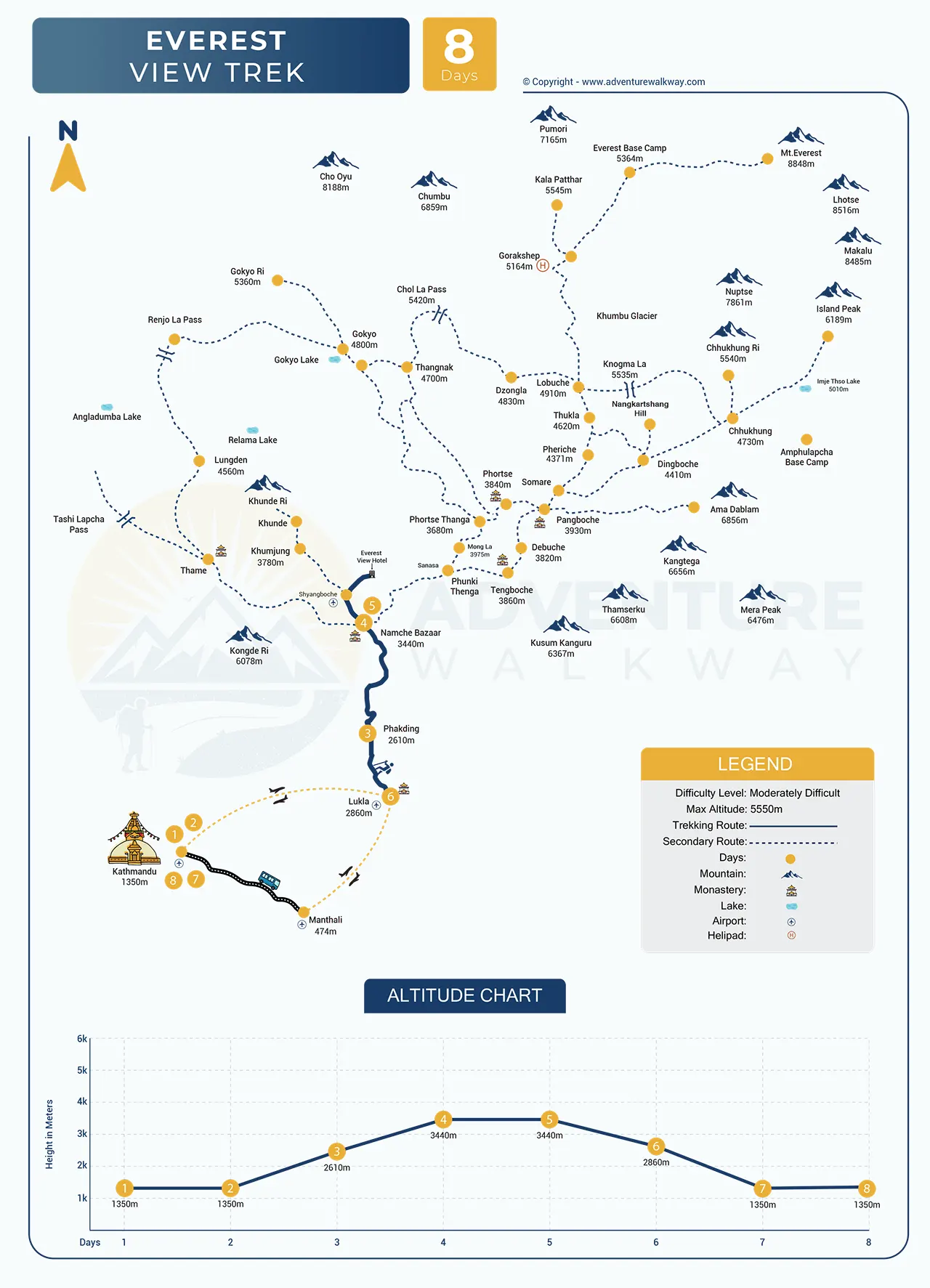
Route Map of 8 Days Everest View Trek
Trip Information
Best Time
The months of spring and autumn are the easiest. Spring weather at lower elevations is pleasant and warm, while autumn delivers cooler, crisp days that are still ideal for the Everest view trek. However, the temperature can drop significantly, especially at night, and it can get quite uncomfortable. Both seasons have something special to offer but have a few challenges.
Spring tends to be the most crowded time, with hikers worldwide hitting the trail. Still, in spring or autumn, you’ll be treated to colorful blooms, lush hillsides, and incredible mountain views under clear skies. Remember that the growing number of trekkers can sometimes detract from the peaceful vibe.
Similarly, if you go on an Everest view trek in the summer, you will encounter monsoon showers, making the routes wet and treacherous. You can expect verdant scenery. However, it’s not ideal for trekkers, but if you mind some rain and want a peaceful experience, it might still be worth considering. Just bring good rain gear.
On the other hand, winter can be harsh with freezing temperatures, especially in the early mornings and at night. While the skies are often clear, the cold can be intense. The trails are less crowded, which some people enjoy. However, the paths will also be very challenging due to snow, and beginners cannot complete this 8-day trek in the cold season.
Elevation and distance
Your 8-day Everest View Trek will set off right in Nepal’s capital, Kathmandu City, where you will be at an altitude of 1350 meters or 4429 feet. Then, you will take a short flight to Lukla, landing at Tenzing Hillary Airport, sitting at a height of 2860 meters (9383 feet) in the Khumbu region.
Then you will go on a walk to Phakding village of Sherpa; the village is in the lap of the mountains at 2610 m (8563 ft). Subsequently, you will continue your journey to Namche Bazaar at 3440 m (11290 feet), where you will acclimatize and take side tours on the mountain spots. You will be staying for two nights in Namche Bazaar.
From Namche, you’ll go to the Everest View Trek’s highest point, Hotel Everest View, at an elevation of 3,880 meters (12,729 feet). It holds the global record for the highest-located hotel. Syangboche is the second highest point on this route, with an elevation of 3880 meters (12729 feet).
The overall hiking distance for this moderate-level journey is around 41 to 44 kilometers (25.5 to 27.3 miles). On the first day of your excursion, you will walk from Lukla to Phakding Village, which is approximately 8 kilometers (5 miles). Similarly, you will need to walk 23 to 25 kilometers (14.3 to 15.5 miles) to reach Everest View Hotel from Lukla.
Finally, on the return journey, you will walk 18 to 19 kilometers (11.2 to 11.8 miles) to reach Lukla from Namche Bazaar, ending your hiking excursion in the Khumbu region. Therefore, you will need to train yourself first before embarking on the 8-day Everest View Trek for basic fitness.
Difficulty and altitude sickness
The Everest View Trekking journey is a reasonably easy adventure in the Khumbu region in contrast to other challenging treks like the Everest Base Camp Trek, Pikey Peak Trek, Gokyo Lake Trek, Renjo La Pass Trek, and many more. Most people, from old to young individuals with good basic fitness, can complete this 8-day journey victoriously.
This journey demands that you walk an average of four to five hours daily with few ascents and descents. You don’t have to push too hard on this journey, as this excursion doesn’t include any passes to cross in the itinerary. You will hike through stone steps, as well as rocky and narrow trails, especially when ascending to the Everest View Hotel.
Thus, this point may be challenging if you are a first-time hiker in the mountains until you reach the highest hotel in the world. However, the rest of your journey isn’t too hard. Even though you are trekking below 4000 meters, altitude sickness must still be considered. If your body can’t adapt to a thinner oxygen level, then you may have the signs of altitude sickness.
Some common symptoms of altitude sickness below 4000 meters of altitude include headache, fatigue, shortness of breath, difficulty sleeping, swelling of hands and feet, and so on. To prevent this, you should stay hydrated, eat light but energy-rich meals, rest properly, and most importantly, inform your trekking partner or guide to seek help immediately.
Maximum and minimum walk per day
This 8-day Everest View Trek demands you to walk an average of four to five hours in the Khumbu region from day 2 to day 6. Out of eight days, you will hike four days continuously in the heart of the Himalayas. So, having basic fitness will help you walk more easily throughout the trek.
The highest amount of time you will trek on this journey will be 6 to 7 hours on the fourth and sixth days when you walk to Namche Bazaar from Phakding Village and return to Lukla from Namche Bazaar.
Likewise, the minimum amount of time you will hike will be on the third day, about 3 to 4 hours, when you travel to Phakding Village from Lukla. This trek is relatively easier than the classic EBC, requiring you to walk for only a few days.
Accommodation, Food and Drink
During the Everest View trek, the package will allow you to sleep in a standard tourist hotel in Kathmandu for three nights with a shared basic bed space before and after the walk-in. Teahouses and lodges will offer basic yet comfortable twin-sharing rooms on trekking trails.
Similarly, while trekking, most accommodations on the trail are clean and modest, with communal bathrooms and limited amenities such as charging stations. During the trek, you will be served full-board meals, which include breakfast, lunch, and dinner, with stunning mountain views outside your window.
You have to pay extra money, from 3 to 5 dollars, if you want to use a hot shower and Wi-Fi at the tea houses. The facilities will be more expensive when you keep going to higher elevations of teahouses during the trek. This trek includes local dishes like dal, bhat, momos, noodles, and soups.
Additionally, you can expect a mix of Nepali and international options. However, you must purchase drinks such as tea, coffee, or bottled water, as they will not be included. Carrying a refillable bottle will be recommended because staying hydrated will be crucial.
Can a beginner join this trip?
The 8-day Everest View Trek is for everybody who wants to see the Khumbu region in a short amount of time without doing any challenging trek. This journey is perfect for those who want to enjoy the beauty of the Himalayas and other breathtaking landscapes. People with kids, female travelers, and old people have also completed this journey successfully.
This journey involves only four days of trekking out of an eight-day itinerary. So, if you want to start the hiking journey and you have never done it before, then this trip is obviously for you. There is a very low chance of getting acute mountain sickness and other risks. So, you can travel this journey stress-free without pushing your limits.
Preparation and fitness
As this is an easy-level short trek in the Everest region, you don’t have to train hard to be ready for this trek. You can simply do regular exercises in your daily routine for basic fitness that will help you a lot when hiking in the steep mountain sections. You should also consult your doctor if you have any current health problems or have had any in the past to ensure a safe trekking experience.
You can start preparing for the Everest View Trek regularly about a month or two ahead by walking for an hour, going on short hikes, and doing stamina-building activities like running, cycling, or swimming. These activities will make your journey easy and comfortable, even if you are a beginner.
Another very important step of trek preparation is the selection of the right clothes and gear. Besides, before you start, you should be fully aware of the climate and the conditions of the place of your trip, which can either directly add to the charm of the place or leave the contrary effect on you.
You should pack comfortable trekking shirts and pants, warm layers like thermals, a down jacket, a windproof or waterproof outer jacket, trekking boots, a small backpack, sunscreen, lip balm, a power bank, a camera with spare batteries, and important documents like travel insurance, a passport, local cash, and so on.
Furthermore, the most critical factor for preparation is having a good mindset and thinking positively. If you feel negatively about yourself and the journey, there is a high chance that your experience will be bad while traveling. So, mental preparation is crucial when hiking in higher-altitude destinations.
Gadgets charging and Internet
On this Everest View Trekking itinerary, you don’t have to worry about electricity. Most of the teahouses that we will spend the night at have this facility, as they lie in lower altitude regions. You can charge any of your electronic devices, like phones and cameras, where you will stay overnight, as they offer charging points. The main source of electricity for teahouses is solar power.
However, due to their remote locations, you may have to pay a small fee for charging gadgets in some Sherpa villages like Phakding and Syangboche. The Everest region’s weather affects the availability of power. So, if you carry a power bank, it can help your gadgets stay on all the time without worrying about shutting down.
Besides this, internet access is available, but the connectivity depends on the location. Lukla and Namche Bazaar have decent internet access. In contrast, Phakding, Hotel Everest View, and Syangboche have unreliable internet access, even though it is available depending on weather and solar power availability.
However, you must pay some extra cash to use the internet service. Our best tip is to buy a local SIM card with a good data plan. It will help you to stay connected all the time and contact your family or anyone you miss with the help of the internet while trekking at the same time.
Permit
You will have to get two essential permits to continue this adventure in the Everest region.
Khumbu Pasang Lhamu Rural Municipality Permit: This permit was introduced by the local government and has now taken the place of the old TIMS card in the Everest region. You can get it from Lukla or Monjo right after you enter the trekking zone for NPR 2000 per person (around 13 to 15 USD).
To apply, you’ll need a copy of your passport and two passport-sized photos- super simple! It costs NPR 3000 per person (around USD 22–25) for foreigners, and it gives you access to the stunning Sagarmatha National Park, which is also a UNESCO World Heritage Site.
Transportation
On this Everest View Trek, we will wait for you at the airport upon your arrival in Nepal to transfer you to your standard hotel in one of the vibrant places of Kathmandu, Thamel. Then, on the next day, we will arrange our private transportation for sightseeing in Kathmandu Valley with a tour guide.
On the third day, we will take a flight to Lukla, where you start your trek. After completing the trek, you will again take flight to Kathmandu City. Finally, we will drop you at the airport, bidding goodbye from Nepal. We cover both your flight and ground transportation.
Travel Insurance
No matter where you travel, you need travel insurance. Similarly, if you do not want any serious issues when you plan for the Everest View Trek, you should make yourself responsible for all the evacuation costs and other expenses. So, you need to have compulsory travel insurance so that these emergency medical treatment and repatriation costs can be covered easily in case of severe issues.
This trip passes through many remote locations without services, and rescue attempts, particularly by helicopter, can be costly. That’s why Himalayan rescue coverage is critical. Insurance can aid with unexpected trip cancellations, missing baggage, or delays due to cancellations. Travel insurance provides piece of mind, even if no one expects problems while trekking.
You will have to make your own arrangements for it because it is not included in the package. With proper coverage, you may completely experience the stunning Himalayan scenery while remaining prepared for anything that may arise.
What to expect from this trip?
From the Hotel Everest View, one of the highest hotels in the world, you can expect to see the remarkable beauty of Mount Everest, Ama Dablam, Nuptse, Lhotse, and many other majestic peaks. Stop and walk through the idyllic Sherpa villages around Namche Bazaar and Syangboche, soaking in the Tibetan-influenced culture that still thrives in the Solukhumbu region.
Have fun with a spectacular and exhilarating flight to Lukla, then continue the trek along the Dudh Koshi River to Sagarmatha National Park, a UNESCO World Heritage Site. This 8-day Everest View Trek brings you picturesque Himalayan views, various Sherpa communities, and their cultures without pushing you too hard with the altitude.
Frequently Asked Questions
On this excursion, you will hike to Hotel Everest View, which is at around 3962 meters or 13000 feet, the maximum elevation.
Yes, it is absolutely safe. Thousands of people visit this area every year, so it’s far from remote. You’ll also have a guide and porter with you, ensuring your safety and supporting you every step of the way. Safety is not something to be underestimated.
If you plan a trek in Nepal, the most favorable seasons are springtime (April and May) and the fall (early September to late November) because of the consistent weather, clear skies, and mild temperatures.
While hiking, altitudes range from 2610 meters to 4000 meters, which could increase the risk of high-altitude sickness. Thus, drinking water, trekking pace, and acclimatization are critical for avoiding acute mountain sickness.
Not at all. Prior hiking experience is not required; however, it can be very helpful as you embark on your quest to complete the hike and check off your travel wish list. Even inexperienced trekkers can complete the Everest View Trek with the right direction, training, and planning.
Yes, it is feasible. On the other hand, it is chilling with the temperature dipping to -20°C or even below in the high-altitude spots. Winter treks may have fewer visitors, but the views of Everest are simply dazzling if one is fully equipped with suitable gear and well-prepared.
Trip Reviews
Price starts
US$ 760
We offer group discounts
- 1 - 1 personUS$ 860
- 2 - 5 personUS$ 760
- 6 over 9999 US$ 660
Total Cost:
US$ 860
Need Help? Ask Questions
Dipendra Dhakal
+977-9851093471 (Whatsapp)