



Dipendra Dhakal
+977-9851093471 (Whatsapp)Jomsom Muktinath Trek – 14 Days
13 reviews in Tripadvisor


Duration
14 Days
Group Size
2-15 Pax
Difficulty
Moderate
Max. Altitude
3,855m. / 12,648ft.
Meals
Breakfast, Lunch, Dinner
Accommodation
Tea House and Lodge
Transportation
Bus & Flight
Activities
Trekking & Sightseeing Price starts
US$ 1199
We offer group discounts
- 1 - 1 personUS$ 1299
- 2 - 5 personUS$ 1199
- 6 over 9999 US$ 1099
Total Cost:
US$ 1299
Need Help? Ask Questions 

Introduction of Jomsom Muktinath Trek – 14 Days
The Jomsom Muktinath trekking route is among the most fascinating in the Annapurna and Mustang regions. Naturally blessed with various geographical structures, cultures, religions, different ethnic groups, and remote villages, the Jomsom Muktinath trek is an entire once-in-a-lifetime experience. Jomsom Muktinath Trek has striking views of the incredible mountain vistas, unique temples, and monasteries along the windy valleys. It is the classic lodge trek in the Mustang region.
Jomsom Muktinath Trek is in the North of Pokhara. It is the classic lodge trek in the Mustang region. The highlight is a trek through the deepest gorge in the world, Dana(1450m), carved by the Kali Gandaki river, which originates in the Tibetan plateau and eventually flows into the Ganges in India. Jomsom Muktinath trek reaches the maximum altitude of 3800m.
This is a moderate-level trek that anyone with moderate-level fitness can complete. It is suitable for a family trek. Although it is a moderate-level trek, there are a few challenges, and the view is advantageous. The trek offers a view of Annapurna I and Dhaulagiri on its side. Both exceed their height of 8000 m. It has hundreds of years-old monasteries as well as caves. This also has local tribes and the scenic beauty of the different landscapes.
Jomsom Muktinath Trek is more than just the marvellous scenic views of mountains and landscapes. The diverse landscape and culture found along this trekking route give great insight into the way of life of Nepali people of various ethnic groups. As the trekking route continues from Gurung and Thakali villages, you will experience pristine Gurung and Thakali culture.
You will find Muktinath, the famous pilgrimage site for Buddhists and Hindus, just a short distance from Jomsom. To Hindus, Muktinath is a sacred place of salvation. They believe that bathing in the waters here guarantees salvation after death. To Buddhists, Muktinath is where the great sage Guru Rinpoche(Padmasambhava), who brought Buddhism to Tibet, came to meditate. The area is a perfect place to find fossilised ammonites, known as Shaligram, which are found all along the upper reaches of Kali Gandaki.
Jomsom Muktinath Trek begins from Pokhara. It follows the world’s deepest gorge on the way up. It takes you to an almost treeless barren. This trek has steep rocky trails up as well as down. The treks begin in the Annapurna region and ascend through rice terraces and villages.
The treks get interesting in Tatopani village. You will have an opportunity to relax in natural hot springs. Passing all the important villages of the Mustang region, you will reach Jomsom. It reveals Nepal’s spectacular diversity at its finest. It flaunts many people and terrains, from subtropical jungles to high and dry landscapes. It resembles the Tibetan plateau.
The Jomsom Muktinath Trek starts from Pokhara and makes its way towards Nayaphul, Poon Hill, Ghasa, Tukche, and Kagbeni, with the last destination being Muktinath. The distance between Jomsom and Muktinath is more than 46km, and if you trek 7-8 hours per day, you will reach the destination in 7 to 9 days.
The trekking route from Jomsom to Muktinath is one of the most enjoyable as you travel from small Sherpa villages, Tamang settlements, apple vineyards, tall and old monasteries, and the curvy terrains of hills and mountains. So, if you are intrigued by the Jomsom to Muktinath trek plans, you are most welcome to book your trip with us.
History of Muktinath
Muktinath is a sacred religious place at the bottom of Thoranga La mountain pass in Mustang, Nepal. Muktinath Temple is dedicated to Lord Vishnu, who plays a vital role in the religious history of both Hindus and Buddhists. It is among the world’s tallest temples, located at over 3800m, and is the only Divya Desam among 107 Divya Desams outside India.
It is one of the Char Dhams in Nepal and is considered the Mukti Kshetra. The old folks and temple priests believe the person visiting any Char Dham is cleansed of their sins and will live a happy and prosperous life. They will also get Mokshya in the afterlife.
Muktinath is also the only home of Shaligram Shila or Shaligram stone, a type of fossilised stone worshipped as one of the abodes of Lord Vishnu, who was cursed to live several years as a stone.
The famous Tibetan Guru Rinpoche founded a considerable temple where he used to rest while he was visiting Tibet, making the place sacred to Buddhist people. Since the Hindus believe Lord Vishnu rested on the bank of the Gandaki River the place, a temple was formed, which became Muktinath.
Hence, Muktinath is essential for the local people and people from the Hindu and Buddhist countries. Still, it is also an equally famous and popular place for tourists from Western civilisation, mainly because of the attractions that they can explore during the treks.
Best Attractions of Jomsom Muktinath Trek
Several unique attractions can tempt many trekkers worldwide to go on a Jomsom Muktinath Trek. The remote landscape, small village settlements, huge mountainous vistas, barren landscapes, apple vineyards, etc., can be considered attractions. Still, three main places that captivate the heart of the trekkers are described below.
Poon Hill
One of the major attractions of the Jomsom Muktinath Trek is Poon Hill. Poon Hill is a beautiful hill station that lies at an altitude of 3210m. You will reach Poon Hill from Pokhara to Poon Hill in 2-3 days. After trekking from Pokhara, you will reach Nayapul, TikeDhunga, and Ghorepani and stay overnight at Ghorepani. The next day, the trekkers are advised to hike towards Poon Hill early in the morning for the time of sunrise. The 360 panoramic mountainous view is one of the best views in the entire country. The Poon Hill trek, in itself, is one of the best treks in Nepal, but if you are going to Poon Hill while trekking from Jomsom to Muktinath, it is an additional bonus.
Marpha
Marpha is another stunning village in the Mustang district in the Dhaulagiri zone. The small town is mainly known for clean roads, helpful, welcoming villagers, and apple vineyards. You will reach Marpha and trek from Tukche for a few hours. Another main attraction of Marpha is the different types of apple dishes like apple pickles and Marpha, which is the local drink made of apples. It is also mainly known for the stone-tilted houses in the village. Although the town is small and impressive, many trekkers following the Annapurna Base Camp Circuit generally stay in Jomsom rather than Marpha, making it less touristy and relatively peaceful.
Thorong La Pass
Throng La Pass is one of the stunning passes between the Manang district and Muktinath. The pass lies on the eastern side of the Muktinath Temple and is the Annapurna Circuit’s highest elevation point. It lies at an altitude of over 5460m north of Annapurna Himal and in the middle of the Damodar Himal. Throng La Pass is famous for the trekkers who are trekking along the Annapurna region, but many traders from Manang and Mustang also use the trail quite often.
Highlights of Jomsom Muktinath Trek – 14 Days
- Explore Holy Muktinath Temple
- A close encounter with the Gurung and Thakali people of the region.
- Experiencing rural trekking and the lifestyle of people
- Walking through the top of the ridge along with the off-the-beaten-path of the Annapurna Region
- Hindu and Buddhist pilgrim’s site in Muktinath sacred 108 water spouts to wash out bad Karma.
- The Apple Orchards in the Marpha village and the special wine and apple products.
Itinerary of Jomsom Muktinath Trek – 14 Days
You’ll be welcomed by the company representative once you arrive at the Tribhuvan International Airport. Transfer to the hotel and meet with the rep once again to get a detailed itinerary of the Jomsom Muktinath Trek once you freshen up. Once the briefing is over, the company guide will tell you about the things you can do here in Kathmandu.

Max. Altitude: 1310m./4,298ft. (Kathmandu)

Meal: Breakfast

Accommodation: Hotel BB
After having breakfast, you will go on a guided city tour. The tour will be for 4-5 hours, and you will see the UNESCO-enlisted world heritage sites of Kathmandu. In the evening, you can stroll around the streets of Thamel and prepare for your Trek.

Activity: Sightseeing
Max. Altitude: 1310m./4,298ft. (Kathmandu)
Meal: Breakfast
Accommodation: Hotel BB
We start our journey early in the morning, traveling by tourist bus out of the valley and along the scenic view of the Trishuli and Marsyangdi rivers. The beautiful scenery along the way includes rivers, terraced fields, villages, and sights of the snowy mountains, including Ganesh and Manaslu peaks. Pokhara is a tourist hub with numerous adventure activities. It’s like a paradise for tourists.
Activity: Flight / Drive
Max. Altitude: 850m./2,789ft. (Pokhara)
Meal: Lunch & Dinner
Accommodation: Hotel
Today, we enjoy a short drive through a fascinating landscape on the way to Nayapul, our trek starting point. Here we start our trek officially. The route follows a pleasant path through the fertile jungle and terraced fields along a rushing river. We pass through several rural settlements and gradually reach Tikhedunga.
Activity: Trekking 5-6hrs
Max. Altitude: 1540m./5,052ft. (Tikhedunga)
Meal: Breakfast, Lunch, Dinner
Accommodation: Lodge
Today we trek from Tikhedunga to Ghorepani. It involves a lot of walking as we climb a long, steep series of stone steps on our way to Ghorepani. After the challenging steps, we journey through scenic villages and timberland. Although a difficult climb, along the way, we can take in fascinating views of the snowy peaks, including the Annapurnas, Machhapuchhare, and Hiunchuli. Our destination is Ghorepani, a spectacular settlement located on a ridgeline.
Activity: 6/7 hrs
Max. Altitude: 2860m./9,383ft. (Ghorepani)
Meal: Breakfast, Lunch, Dinner
Accommodation: Lodge
We start our hike very early, before sunrise today, to reach Poonhill for the breathtaking view of sunrise on the Himalayas. The majestic panoramic view from Poon Hill includes Dhaulagiri, Nilgiri, the Annapurnas, and much more. After enjoying the views, we follow a pleasant forest trail through rhododendrons and villages with terraced farmland to eventually cross the Kali Gandaki river and arrive at Tatopani with nearby hot springs, where we take a dip and savor the experience.
Activity: 6/7 hrs
Max. Altitude: 3210m./10,531ft. (Tatopani)
Meal: Breakfast, Lunch, Dinner
Accommodation: Lodge
Today, he heard towards the north we follow upriver in the Kali Gandaki valley. We explore newly developed trails away from the motor road. We will pass through beautiful farmland with rural villages surrounded by terraced fields. We are hiking up the world’s deepest gorge, with Dhaulagiri, the world’s seventh-highest peak on one side, and Annapurna I, the tenth-highest on the other. We ascend to the beautiful village of Ghasa, mainly populated by the Thakali people of this region.
Activity: 5 hrs
Max. Altitude: 1355m./4,446ft. (Ghasa)
Meal: Breakfast, Lunch, Dinner
Accommodation: Tea House
We continue our journey up the Kali Gandaki. We pass through peaceful forests to the large settlements of Lete and Kalapani, and as we continue the journey north, the territory becomes noticeably drier and the lush vegetation and forests give way to more desert-like terrain. The culture, too, begins to change from the lowland Hindu style practices to a Buddhist lifestyle. Tukche is a picturesque village with surrounding orchards and a monastery. The local brandy from Tukche is famous throughout Nepal and a hit with many trekkers.
Activity: Trekking
Max. Altitude: 2510m./8,235ft. (Tukche)
Meal: Breakfast, Lunch, Dinner
Accommodation: Lodge
We pass through the scenic village of Marpha, famous as part of the Annapurna Circuit for its apple pies, before road building dramatically decreased tourism. We enjoy exquisite views of the surrounding peaks and marvelous landscapes. Jomsom is the next town and district headquarters of Mustang. The route then follows the arid valley of the Kali Gandaki River to the fort of Kagbeni, an ancient trade post with a Buddhist monastery, too. Kagbeni is just south of the restricted area of the Upper Mustang.
Activity: Trekking
Max. Altitude: 2900m./9,514ft. (Kagbeni)
Meal: Breakfast, Lunch, Dinner
Accommodation: Lodge
Today, we will make a thrilling journey up the valley in the direction of Thorong La Pass. We make a scenic climb up the Jhong River valley with majestic scenery along the way. The trail passes ancient villages on the way to Muktinath, a temple that has long been a pilgrimage destination for Hindus and Buddhists alike. The temple’s walled complex has a Buddhist monastery and Hindu shrines, 108 bathing spouts, and even an ‘eternal flame.
Activity: Trekking
Max. Altitude: 3855m./12,648ft. ( Muktinath)
Meal: Breakfast, Lunch, Dinner
Accommodation: Lodge
We are almost in the final days of our trek. The journey heads down the valley, we lose elevation and gradually rejoin the Kali Gandaki River valley bottom and the trail back to Jomsom. Jomsom’s market area may seem different from the upper valley; it is more urbanized and facilitated. We enjoy our last day in Jomsom by exploring the market, or we can just rest and refresh in our lodge.
Activity: 5 hrs
Max. Altitude: 2720m./8,924ft. ( Jomsom)
Meal: Breakfast, Lunch, Dinner
Accommodation: Lodge
We make our final goodbyes to Mustang and head back to the tourist hub of the country, Pokhara. Our scenic flight returned us to Pokhara. Finally, after a vigorous trek and adventure, we relax on the lakeside. Pokhara is a beautiful city, and also the vacation capital of the country. We can then connect with a flight back to the ancient city of Kathmandu, or take a day of exploration of Pokhara and a tourist bus to Kathmandu the following day. I recommend taking a rest day in Pokhara and exploring the city or just being in a tourist haven. Pokhara is worth exploring.
Activity: Flight
Max. Altitude: 1310m./4,298ft. (Kathmandu)
Meal: Breakfast, Lunch, Dinner
Accommodation: Hotel BB
Today is an early start as we depart by tourist bus for a return to Kathmandu. The 200 km route follows first along the Marsyangdi River and then the Trishuli River, offering a good look at the natural scenery and farmland. The bus makes one last climb, and we are back in the valley of the gods, Kathmandu.
Activity: 1hrs
Max. Altitude: 1310m./4,298ft. (Kathmandu)
Meal: Breakfast, Lunch, Dinner
Accommodation: Hotel BB
A representative from Adventure Walkway will drop you at Tribhuwan International Airport for your Departure. You will then proceed with your immigration.
Max. Altitude: 1310m./4,298ft. (Kathmandu)
Meal: Breakfast
Includes/Excludes
What is included?
- Pick-up & Drop from the airport on the day of your arrival & Departure
- 3 Night Tourist Standard Hotel in Kathmandu
- The Government Register’s English-Speaking Guide
- If the group size exceeds 6 people, an assistance guide will be provided.
- One porter for two clients
- In trekking trails, accommodation is on a twin-sharing basis
- Breakfast, Lunch, and Dinner are included.
- Trekking map
- Trekking Permit & TIMS Card
- Transportation as per itinerary
- Staff salaries, insurance, meals, accommodations, equipment, transportation, etc.
- Arrangements for emergency rescue services (Please make sure you have medical insurance from your country)
- The agency service charge and the government tax/VAT
- The certificate of achievement towards the Trip
What is excluded?
- The cost of international airfare
- Visa fees for Nepal
- All drinks During the Trip (Tea, Coffee, Cola, Beer, Mineral Water)
- Personal Costs
- Smoke
- Insurance for travel
- If more than the 3-night hotel in Kathmandu
- Kathmandu meals
- Hot shower during the trekking
- Batteries and cameras that are chargeable during the trek
- Natural or political disturbances beyond our control result in additional costs.
- The Extra cost of any case early return from the trip.
- Tips for Trekking Staff
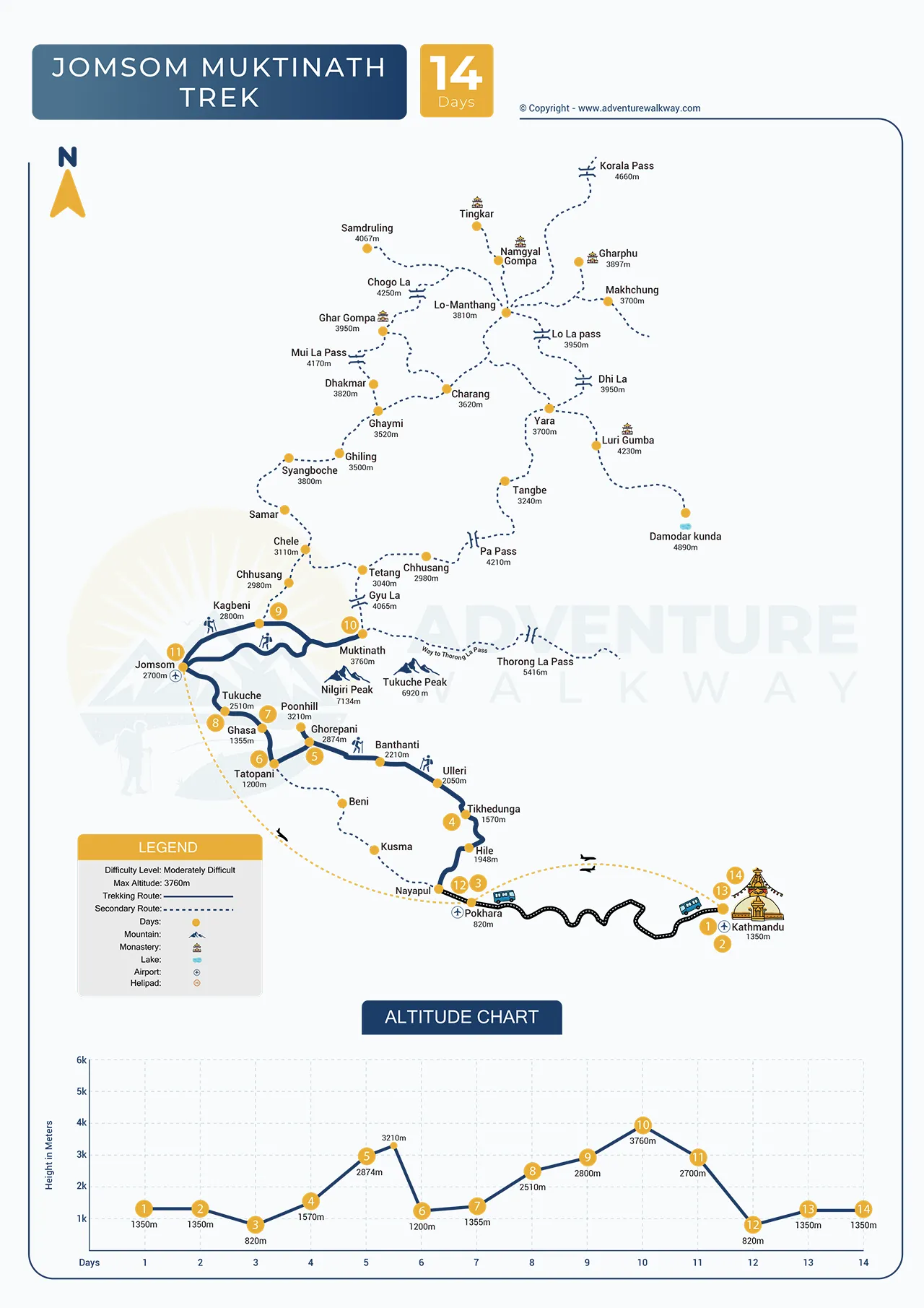
Route Map of Jomsom Muktinath Trek – 14 Days
Trip Information
Best Time
The best season for the Jomsom Muktinath Trek—14 Days is spring (March to May) and autumn (September to November). These seasons are characterized by clear skies, moderate temperatures, and excellent mountain vistas, which make trekking more enjoyable and safer.
Spring adds blooming rhododendrons and fresh greenery to the landscape, while autumn provides cool air and post-monsoon clarity.
The winter months (December to February) are colder with possible snow at higher elevations, but the trail is open and sees fewer trekkers. Trekkers must prepare for sub-freezing temperatures and limited services, however.
The monsoon season (June to August) is the worst time, as there is rain and landslides in lower areas, but Jomsom and Muktinath lie in a rain-shadow zone, so the trek is still possible with care. Though the trek is possible throughout the year, off-season months require the right equipment, flexibility, and physical conditioning because of weather conditions and reduced open lodges.
Elevation and Distance
The Jomsom Muktinath Trek—14 Days has a total trekking distance of approximately 100 to 120 kilometers traversed in 8 days of trekking. The highest point reached by the trek is Muktinath, standing at 3,855 meters / 12,648 feet, a holy pilgrimage site situated below the Thorong La Pass.
Pokhara, at 850 meters / 2,789 feet, stands at the lowest altitude, from where the trekking trip begins. The route ascends steadily through varied countryside—lowlands and rhododendron forest as far as the eye can see, then trans-Himalayan dry land.
Trekkers experience significant variation in elevation, especially between Tatopani (1,200 m) and Muktinath (3,855 m), necessitating steady acclimatization. Altitude can strike some trekkers, however, even with a gradual ascent, above 2,500 meters. Trekkers trek 10 to 15 kilometers a day on average, up to 5 to 7 hours a day.
The trail cuts through the Kali Gandaki Valley—a portion of the planet’s deepest gorge—offering a combination of cultural splendor and geographical diversity along its entire length.
Maximum and minimum walks per day
Day 5 on the Jomsom Muktinath Trek—14 Days is the most challenging trekking day, trekking from Tikhedunga to Ghorepani, which is 6 to 7 hours of continuous uphill trekking on stone steps and forest trails. This is the toughest physical day because it is a relentless climb.
Day 10 is the shortest hike of the day, from Kagbeni to Muktinath, and takes about 4 hours—a less demanding hike but with significant altitude gain. We walk an average of 5 to 6 hours a day, and each day there is some variation depending upon the terrain, altitude, and weather.
Trekking days are generally gentle ups and downs over forest, village, riverbed, and dry Himalayan ground. The trip is organized with easy trekking, proper acclimatization, and sufficient time to enjoy scenic as well as cultural sights along the way. Proper rest and drinking water ensure energy supplies at par levels on this moderate trek.
Accommodation
Accommodation on the Jomsom Muktinath Trek—14 Days is 3 nights of tourist-standard accommodation in Kathmandu on a twin-sharing basis with an en-suite bedroom and breakfast.
Along the trekking trail, we stay in local teahouses or lodges, also on a twin-sharing basis. The rooms are generally clean, warm, basic, and cozy, with the provision of basic bedding and blankets.
In lower elevations like Tikhedunga and Tatopani, attached Western-style toilets are relatively common, but in higher elevations like Muktinath or Ghorepani, Eastern-style communal toilets are the standard.
Some lodges offer room heating, especially in colder places, but in most cases, there is limited heating, with only the dining hall being heated, where trekkers will generally gather for food and warmth.
Though the accommodations are plain, they are nice for a comfortable visit and are a credit to local hospitality and mountain ways. A sleeping bag is recommended to add warmth on cool evenings at higher elevations.
Food and Drink
At the Jomsom Muktinath Trek—14 Days, Breakfast, Lunch, and Dinner (BLD) are provided daily. Food includes local and healthy food products like dal bhat (rice and vegetables with lentil soup), fried rice, noodles, soups, porridge, pancakes, and Tibetan bread. Tea, coffee, eggs, and toast are included in breakfast.
Vegetarian food is highly recommended for lunch and dinner for hygienic and digestive reasons at high altitudes.
Although these major meals are provided for, other items such as snacks, soda, and bottled water must be purchased additionally. We recommend that meat and alcohol should not be eaten on the trek because they are dangerous and unhealthy.
Alternative Routes
The Jomsom Muktinath Trek has several different alternatives to suit different interests and time frames. An option is the 6-day short trek with a start by flying from Pokhara to Jomsom, trekking to Kagbeni and Muktinath, and returning through Marpha and Tatopani. This route provides a condensed overview of the region’s sights.
For a longer journey, the Annapurna Circuit Trek also does the Jomsom-Muktinath section and continues to cover the Thorong La Pass (5,416 meters) to make it a complete tour of the Annapurna region.
Another alternative is the Upper Mustang Trek that extends beyond Muktinath to the restricted Upper Mustang region with its prosperous Tibetan civilization and desert landscape.
Also, others hike on paths that skirt the motor road and take trails via villages like Lubra in order to experience more authentic routes and serene environments.
They cater to various interests, from cultural adventures to challenging high-altitude trekking.
Can a beginner join this trek?
The Jomsom Muktinath Trek—14 Days is possible for people who are just starting out because it’s one of the simplest treks in this area. Since the trail is not very high and Muktinath’s peak is 3,855m, proper acclimatization makes it possible for anyone.
Since each day consists of 4 to 7 hours of walking, it is best for people with average fitness. Yet, it’s smart for new hikers to include light cardio and some hiking before attempting the trail.
You should consider hiring someone to help you with the trek. A positive mind and some preparation will let beginners have a comfortable time on this trek.
Preparation and Fitness
Taking the time to prepare and stay fit is necessary for completing the Jomsom Muktinath Trek easily. Because the trek is moderate, you should start training your cardio at least 4–6 weeks before by walking, jogging, cycling, or swimming.
Taking hikes with a backpack will strengthen your legs and make you stronger. You should also mentally prepare since the trek takes many hours, and the conditions you’ll encounter are simple by mountain standards.
Don’t bring too much—just make sure you have good walking shoes, warm clothes, and a first aid kit. A good attitude and a regular pace help you reach your destination.
Gadget charging, Internet, and communication
During this trek, you can find places to charge electronic devices at most of the teahouses and lodges you will pass. But at higher altitudes, you’ll notice electricity is scarce, and charging your phone may result in a surcharge that varies between $2 and $4 hourly. You should have a power bank or solar charger with you to avoid your devices running out of power.
In a lot of lower lodge places in higher country, you can connect to the Internet using Wi-Fi with a card purchase for NPR 350–500. However, the link to the internet can be very slow and unreliable when you get to higher places. It’s a good idea to use an Ncell or NTC SIM card bought locally in Kathmandu, since it has 4G coverage in many parts of the trail.
You may not be able to use mobile networks in every area, so most guesthouses provide phone service at an extra cost, and a guide typically has a local phone you can use for emergencies. Always have the right resources and make a plan ahead to ensure your devices are charged whenever you’re in an area with limited internet.
Permit
Anyone attempting the Jomsom Muktinath Trek needs to get the ACAP, since it is required when entering the Annapurna region. A Trekkers’ Information Management System (TIMS) card is also needed to manage the safety and registration of people trekking in the area.
Getting permits is easy in Kathmandu or Pokhara before you begin your trek. Always have your permits with you since at each checkpoint, they must be shown to park rangers.
For anyone interested in traveling further to the Upper Mustang region, an extra Restricted Area Permit (RAP) issued by a registered trekking agency is needed. These permits are designed to control trekking and save the important natural and cultural sights in the area.
Transportation
Transportation is set up to be comfortable for everyone and properly suited to the travelers on the trek.
You will receive airport transfers in Kathmandu and be moved easily from Tribhuvan International Airport directly to your hotel. Day 3 is scheduled for a ride on a scenic bus or with a quick flight from Kathmandu to Pokhara. Nayapul is the official beginning of the trek, and from Pokhara, you can reach it by private vehicle.
Following the trek, you will not drive all the way but fly back to Pokhara from Jomsom. People in our groups reach Kathmandu from Pokhara using either a tourist bus or a flight, whichever matches their preferences and group size.
All services are reliable, and you can expect a safe and lovely journey that matches your group’s requirements.
Insurance
You must have insurance to do the Jomsom Muktinath Trek. The policy should include emergency medical cover for hospitalization and, in turn, medical flights by helicopter if they are needed. Accidents, injuries, and illnesses during trekking require proper coverage.
Trip cancellation, delayed travel, and loss or theft of personal items are events that must be included in your insurance plan. Trekkers should consider adding health insurance for altitude sickness while planning for treks in the Himalayas.
Travel insurance covers you financially and gives you comfort if something unexpected happens while on your trek. Always see if your insurance covers the activities you plan to do at a high altitude before setting off.
What to Expect
You will see some incredible sights and experience local culture on the Jomsom Muktinath Trek. The views you’ll see here range from beautiful forests and terraced ridges to dry valleys like the desert. Dhaulagiri and Annapurna are just some of the beautiful Himalayan mountains you can see from this route.
While traveling, discover traditional villages, Buddhist temples, and Hindu shrines, most obviously at Muktinath. Although the trail involves some climbing and walking, it is easy for anyone with ordinary fitness. You can expect comfortable lodges, friendly greetings, and the chance to explore the mix of Hindu and Buddhist traditions.
Trek Difficulty of Jomsom Muktinath Trek
Jomsom Muktinath Trek is relatively easy compared to many trekking routes in Nepal, especially in the Mustang region alone. The Upper Mustang Trek is restricted and arduous; however, the Jomsom Muktinath trek is still challenging and will provide thrill and adventure to trekkers worldwide. There are also a few trekking difficulties you must overcome to enjoy them thoroughly, so let’s take a look at them.
Altitude Sickness
One of the less probable trek difficulties trekkers tend to suffer during the Jomsom-Muktinath trek is the chance of altitude sickness. Altitude sickness is becoming sick at a higher altitude, generally from 3000m above sea level. The Jomsom-Muktinath trek is generally a lower-level trek, so the chances are slim for trekkers with any experience. Still, it might affect someone with a history of previous sickness.
The symptoms of Altitude sickness are feeling dizzy, difficulty walking, headache, fever, fatigue, and shortness of breath. You will get medicine such as Diamax for a quick remedy, and if you lower the altitude towards Kagbeni, the body can feel much more relief.
Continuous Walking
The main trek difficulty that trekkers might face during the Jomsom-Muktinath trek is the religious trekking for several days. Trekkers must walk 6-7 hours daily, which can cause fatigue, tiredness, soar back, and soar feet. However, the trek must be easier if you are physically fit and go for a walk or run every morning. Hence, if you are planning the trek, it is essential to be physically healthy months before the start of the trek.
Essential Items
Although Jomsom Muktinath is a reasonably easy to moderate-level trek, it is still essential to prepare for the trip if you are going on a dangerous trek. The essentials in all the lower-level treks are different, and you also do not have to carry heavy items like ropes, heavy bags, extra clothes, gloves, or shoes.
Some of the essential items that you must carry during the Jomsom Muktinath Trek are a Sleeping Bag, Maps, Water Purifiers, Trekking items like shoes, ropes, and sticks
Hence, these are the prerequisite items you must carry whenever you go on a trek, whether a lower- or higher-level trek. In a higher-level trek, you must take some extra items alone or with a porter.
Moreover, you must carry additional clothing or items based on the season. If you trek during the winter season, it is essential to have more woolly clothes, but if you travel in the summer, then simple windcheaters or jackets will do the job.
Frequently Asked Questions
Although hiring a porter is optional if you are alright carrying your bags, hiring a guide is compulsory as it falls under government regulations.
Yes, Drinking or mineral water is available at almost every stop, town, village, or city during the trek. You can also ask for hot water in the lodge, hotel, or teahouse where you stay.
The Annapurna Conservation Area Permit is a must to trek the Jomsom Muktinath Trek route.
The Autumn season, from September to November, is considered the best time for the trek, and the second best season is Spring.
The highest elevation you will climb during the trek is 3800m, the top of the Muktinath Temple.
Trip Reviews
Price starts
US$ 1199
We offer group discounts
- 1 - 1 personUS$ 1299
- 2 - 5 personUS$ 1199
- 6 over 9999 US$ 1099
Total Cost:
US$ 1299
Need Help? Ask Questions
Dipendra Dhakal
+977-9851093471 (Whatsapp)