



Muktinath Heli Tour
13 reviews in Tripadvisor


Duration
1 Day
Group Size
2 to 5 People
Difficulty
Easy
Max. Altitude
3,800m. / 12,467ft.
Transportation
Helicopter
Activities
Sightseeing
Dipendra Dhakal
+977-9851093471 (Whatsapp)Meet Mr. Dipendra Dhakal, a pioneer of Nepal tourism, who began his career as a trekking guide and has extensive experience in tour management and itinerary planning.
Introduction of Muktinath Heli Tour
Muktinath is an important pilgrimage site in the Mustang region of Nepal, visited by both Hindu and Buddhist pilgrims. The temple is situated at a height of 3,710 m (12,172 ft) amongst the mountains, with arid hills, deep valleys and Himalayan views. It takes 1 day or more to reach Muktinath by land, but a helicopter allows one to visit Muktinath and return the same day.
The Muktinath Heli Tour is for those who don’t have much time, or who want a shorter and more comfortable tour. The flight will be a direct one to the Muktinath area, bypassing the long road trip through the mountain area. You also have the opportunity to see the changing face of Nepal from the air: green hills and river valleys to Mustang’s dry land.
The Muktinath Helicopter Tour from Kathmandu typically begins early in the morning. Before the helicopter ride, our team arranges the hotel pickup and transfer to the airport. This flight lasts around 1 hour and 15 minutes, depending on weather and flight conditions. Once you have landed, you will have approximately one hour to visit the temple area before you head back to Kathmandu.
The Muktinath Helicopter Tour from Pokhara is a shorter tour for those who have stayed on in Pokhara. It takes about 40-50 minutes to reach Muktinath by air. The trail winds through the mountain scenery towards Mustang, offering glimpses of the hills, valleys and ranges of the Himalayas when weather permits.
The main objective of the trip is to reach the temple of Muktinath and to visit the sacred site there. Prayers, Darshan and visiting the significant parts of the temple complex are possible. The main temple, 108 water spouts and the nearby Jwala Mai shrine are all located on the site. The Temple is located at a high elevation, so it is advisable that you take it slowly and don’t exert yourself unnecessarily during the visit.
Morning flights are usually preferred as the mountain weather is more stable in the morning. The helicopter movements are, however, always subject to the real weather conditions, visibility, aircraft conditions and operational requirements. Flights may be delayed or rescheduled if conditions are not conducive to safe travel.
It is recommended for pilgrims, family members, older people and people who want to see Muktinath, but not for a long road trip or multi-day trek. It is also convenient for tourists with a tight itinerary who wish to head back to Kathmandu or Pokhara on the same day.
The Adventure Walkway organizes all necessary tour facilities, such as airport transfers, helicopter tours and hotel bookings, to ensure that the tour is hassle-free for visitors from when they arrive until they go back home.
What Makes the Muktinath Heli Tour Different?
The major difference with the Muktinath Heli Tour is that you can visit Muktinath without spending a lot of hours on the mountain roads. This helicopter ride will get you right to the Muktinath area, which is convenient for those who have limited time.
The journey is also a part of the experience. In the skies, you can see the green hills, deep valleys, rocky terrain of the mountains and Himalayan peaks (depending on the weather and visibility).
Once you have landed, you have enough time to visit Muktinath Temple, pray and view key parts of the temple complex.
One plus is the starting point. The flight from Kathmandu or Pokhara can be taken depending on where you are staying and how your trip is planned in Nepal.
Quick Tour Facts
Muktinath Heli Tour is a day tour of Muktinath for those who want to visit Muktinath without making a long road trip. The journey can begin from Kathmandu or Pokhara as per the travel itinerary. The helicopter will land close to the Muktinath area, which will allow you enough time to visit the temple before the helicopter returns to your starting point.
| Tour Fact | Details |
| Tour Name | Muktinath Heli Tour |
| Starting Points | Kathmandu or Pokhara |
| Destination | Muktinath, Mustang |
| Muktinath Elevation | (3,710 m / 12,172 ft) |
| Tour Type | Helicopter sightseeing and pilgrimage tour |
| Kathmandu Flight Time | Approximately 1 to 1.25 hours each way |
| Pokhara Flight Time | Approximately 40 to 50 minutes each way |
| Time at Muktinath | Around 1 hour |
| Tour Duration | Approximately 3 to 5 hours, depending on starting point and flight operations |
| Best Seasons | Spring and autumn |
| Main Activity | Muktinath Temple visit and darshan |
| Transportation | Helicopter and private hotel transfers |
| Meals | Breakfast |
| Accommodation | Not included; same-day return |
Highlights of Muktinath Heli Tour
- Direct helicopter flight to Muktinath from Kathmandu or Pokhara, Nepal.
- Visit the sacred Muktinath Temple (3,710 m / 12,172 ft)
- The aerial photograph of the Annapurna and Dhaulagiri mountain regions.
- Transforming landscapes from green hills to the dry land of Mustang
- 1 hour for darshan, prayer and sightseeing at Muktinath
- See the renowned 108 water spouts in the world-famous Muktinath temple complex.
- See the Jwala Mai shrine and its sacred natural flame
- Meals on the road are a thing of the past and you are not going to drive up and down the mountain all day.
- The shorter a helicopter trip is from Pokhara, the better.
- Facilitates pilgrimage by auto and accommodation is provided at the hotel.
Itinerary of Muktinath Heli Tour
Flight to Muktinath
The day starts very early in the morning, when guests are picked up from the hotel and transferred to Tribhuvan International Airport. Our crew will help you at the airport and lead you to the helicopter departure point. The departure time is typically about 7:00 AM, but may vary depending on weather and flight conditions.
After take-off, the flight proceeds west to the Himalayan area of Mustang. Normal travel time is 1 hour and 15 minutes. On the journey, one can gaze upon the changing landscapes of Kathmandu Valley, hills and mountains of central Nepal. The terrain is becoming drier and more rocky as the helicopter approaches Mustang.
It is also a route that offers a view of the Himalayan ranges and valleys along the route. Your guide will be able to indicate certain geographical features and mountain areas where it is safe to do so. Flight times for helicopters may be subject to change for various reasons, such as weather, air traffic and operational requirements, so please use the flight schedule as an approximation.
Landing at Muktinath and Temple Visit
The helicopter will then fly to the Muktinath area, where it will take off from a helipad located close to Ranipauwa. Muktinath (3,710 m / 12,172 ft) is a significant site for pilgrimage for both Hindus and Buddhists.
Together with a guide, you will walk to the temple complex from the landing place. The distance that is walked will vary depending on the helipad used and actual flight activity. Landing of helicopters might be near the temple; others may need a longer walk. Local transport and/or a horse may also be offered at extra cost as required.
You will get darshan and other religious activities at the temple. The main temple of Lord Vishnu, 108 water spouts and nearby Jwala Mai Shrine are part of the Muktinath complex. According to the Nepal Tourism Board, it is a holy place for both Hindus and Buddhists.
Before heading back toward the helipad, you can pray, visit the temple area and watch the religious activities. Muktinath being a high-elevation place, it’s wise to move slowly and not to put in extra physical exertion during the visit.
Flight Back to Kathmandu
Once you have toured the temple, you’ll be at the helipad to board the helicopter and make the trip home to Kathmandu. Typically, the trip back lasts approximately 1-1.5 hours, depending on the route, weather conditions and any operational stop that may have to be made during the flight.
This return leg offers a return flight over the Mustang landscape, mountain valleys, rivers and Himalayan ranges. From there, you’ll fly back to Tribhuvan International Airport, where our team will pick you up and transfer you to your hotel.
The full helicopter experience usually takes about a few hours, but may vary based on weather conditions, helicopter activities, refueling and Muktinath time. This is the typical model for same-day Kathmandu return helicopter tours.
The tour includes the Muktinath Temple visit and Helicopter tour, Darshan and sightseeing, breakfast and includes approximately 320 km of travel by air and 4 hours of touring, including the temple visit.
Flight to Muktinath
Muktinath helicopter tour from Pokhara begins early in the morning. Our staff will pick you up from your hotel and drive you to Pokhara Domestic Airport. Normally, the pickup is around 7:00 AM and the airport check-in and setup for the helicopter flight are completed.
Once you board, the helicopter takes off from Pokhara towards the Mustang Area. In normal flight conditions, it takes about 45 minutes to fly from Pokhara to the Muktinath area. The route is much shorter than the overland route and will not require several hours of mountain driving to reach the pilgrimage site. Information for the current helicopter tour is also available, with an air distance from Pokhara to Muktinath of around 76 km.
En route, one can view the hills and valleys near Pokhara before entering the mountainous environment of the Annapurna region and Dhaulagiri region. After landing further north, the helicopter passes from a green hillside to the more arid and rocky land of Mustang.
If visibility is good, the guide/helicopter crew may be able to assist with identifying important mountains and geography. Flight times may vary due to the fact that helicopter flight in the mountain area is weather- and visibility-dependent.
Landing at Muktinath and Temple Visit
Helicopter is landing at a helipad in the Muktinath region. The site of the pilgrimage is at an altitude of 3,710 m / 12,172 ft in Mustang. It is a significant religious site for both religious groups (Hindu and Buddhist).
Following your landing, you head towards the Muktinath Temple with your guide. Walking distance varies with the particular flight, depending on the helipad that is used. Some operations are close to the temple, while others utilize a landing area that demands a longer walk. If you are unable to walk, you can hire a horse locally for an extra charge, if available.
After entering the temple area, you will have time for “darshan” (worship), prayer and sightseeing. The primary temple is dedicated to Lord Vishnu and the complex is also significant for Buddhist pilgrims. It is also the site of the famous 108 water spouts and the shrine of Jwala Mai, where there is a sacred flame.
Participate in religious activities as you feel the urge and time allows. The temple is located at a high elevation, so take your time while walking and don’t rush – allow yourself to come up to height with the thin air.
Flight Back to Pokhara
At the end of the visit, you will head back to the helipad, where you will be ready for the return flight. Normally, the helicopter takes approximately 45 minutes to fly back to Pokhara from Muktinath.
The tour back is along the scenic topography of the hills towards Pokhara. From the helicopter, you can fly over the Annapurna and Dhaulagiri regions and then head down to the Pokhara Valley.
From Pokhara Domestic Airport, our team will arrange your transfer to your hotel. The duration of the full tour is about three hours, but that may vary depending on the weather, flight operations and the time spent at the temple.
The activities include a helicopter flight, visiting Muktinath Temple, darshan and sightseeing and the duration is approximately 3 hours, which includes the temple visit and breakfast.
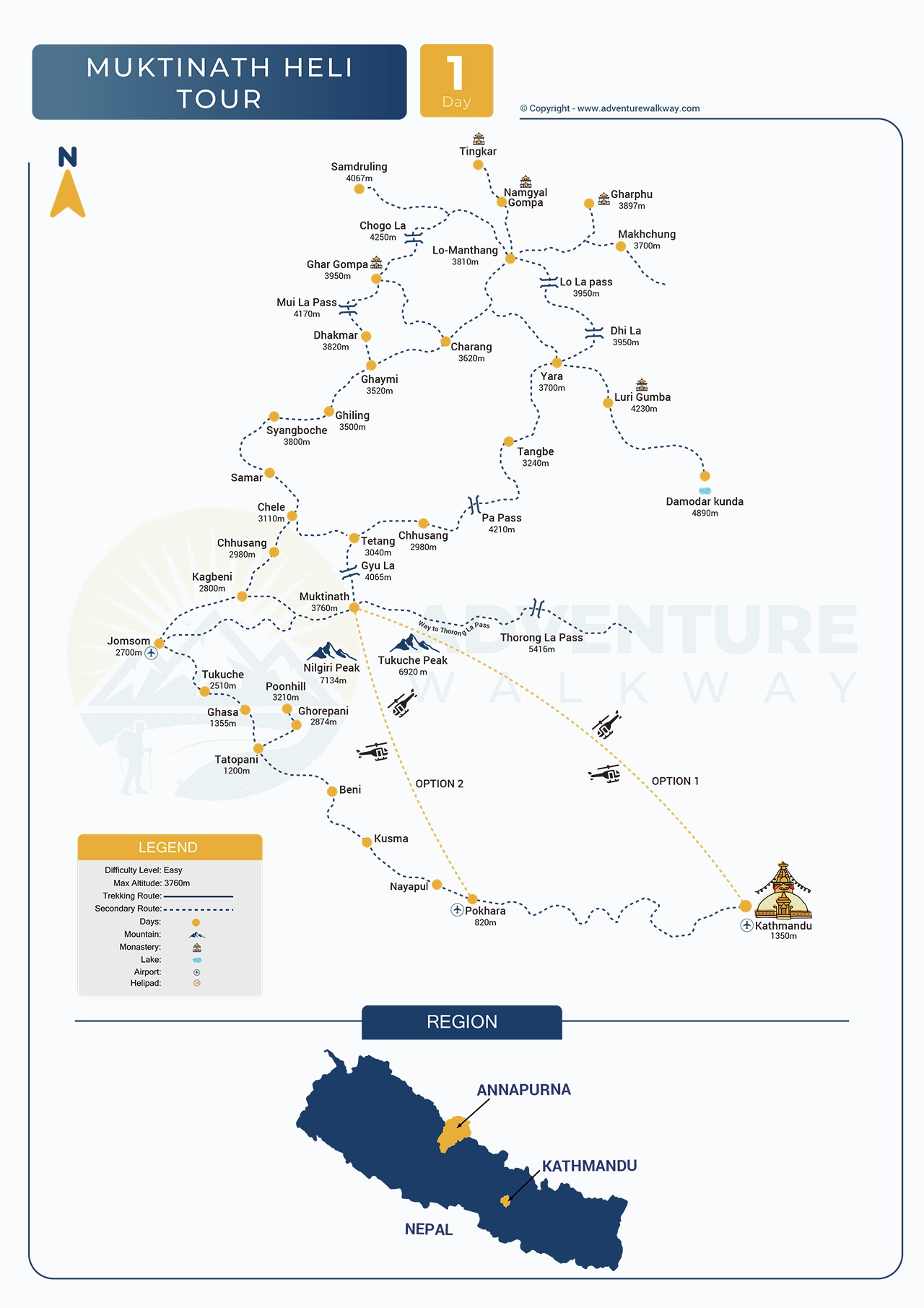
Route Map of Muktinath Heli Tour
Trip Information
Kathmandu vs Pokhara: Which Starting Point Is Better?
| Starting Point | Flight Time | Main Advantage | Best For |
| Kathmandu | About 60 to 75 minutes each way | Convenient if you are staying in Kathmandu | International travelers and Kathmandu visitors |
| Pokhara | About 40 to 50 minutes each way | Shorter flight and less travel time | Travelers already staying in Pokhara |
Either starting point is suitable for the Muktinath Heli Tour. The selection can largely depend on your accommodation choice before the trip.
If you are starting your tour in Kathmandu and are not planning to go to Pokhara separately, then a Muktinath Helicopter Tour from Kathmandu is useful. Early departure and return by helicopter.
The time taken for the Muktinath Helicopter tour from Pokhara is less than the flying time. If you are already traveling to Pokhara, this is a convenient option. Hotel transfers and other necessary support can be arranged by Adventure Walkway from either starting point.
Best Time for the Helicopter Tour
| Month | General Conditions | Suitability |
| January | Cold, generally clearer mornings | Good |
| February | Cold with improving conditions | Good |
| March | Mild weather and clearer skies | Excellent |
| April | Clear mornings and good visibility | Excellent |
| May | Warm days with possible afternoon clouds | Very good |
| June | Monsoon begins in many areas | Weather dependent |
| July | Frequent clouds and rain in Nepal | Less reliable |
| August | Monsoon conditions continue | Less reliable |
| September | Conditions gradually improve | Good |
| October | Clear skies and stable weather | Excellent |
| November | Clear and cool conditions | Excellent |
| December | Cold but often clear | Very good |
The Muktinath Heli Tour is best run in the spring and autumn months. Normally, March-May and September-November offer better mountain visibility and more stable flying conditions.
Clear views can also be obtained during the winter, but it is rather cold around the temple at that time. In the monsoon months, flights may also be run if conditions are suitable; however, the weather conditions of cloud, rain and poor visibility can have an impact on the flight schedule.
Why Morning Flights Are Preferred
Generally, mountain flights are better scheduled in the morning, as it is usually better on the morning and the weather is usually better. This is especially important when flying towards Mustang, as wind and cloud conditions can alter rapidly.
Early departure also ensures you’ll have a good chance of seeing the surrounding mountains and valleys clearly if you are planning a Muktinath Heli Tour. Flights often take off in the early morning for this reason.
Another is the great wind which can arise later in the Kali Gandaki Valley. Conditions in the afternoon may then be less favorable for operations by helicopter. Departure times may vary with the conditions of the airport, weather and the availability and operational needs of the aircraft.
Distance and Flight Duration
| Route | Approximate Air Distance | Typical Flight Time |
| Kathmandu to Muktinath | Approximately 160 to 170 km | 60 to 75 minutes |
| Muktinath to Kathmandu | Approximately 160 to 170 km | 60 to 75 minutes |
| Pokhara to Muktinath | Approximately 50 to 80 km | 40 to 50 minutes |
| Muktinath to Pokhara | Approximately 50 to 80 km | 40 to 50 minutes |
Some helicopters may not travel the same route, resulting in different distances. The flying time can also vary depending on the weather, air traffic, aircraft performance and operational requirements.
Compared with the flight from Pokhara, a Muktinath Heli Tour from Kathmandu generally takes longer to fly. Most tour schedules today indicate an hour to an hour and 15 minutes flight from Kathmandu and Pokhara is about 45 minutes.
The above are “approximate” and not a guaranteed flight schedule.
What Happens During the Landing?
The helicopter touches down at a helipad in the Muktinath area. Once the aircraft has come to a complete stop, the crew or ground personnel will tell you when it is safe for passengers to leave and there is no need to stand up.
The landing area is near the temple, but the walking time to the temple will vary, depending on the landing area used on the day. The present tours refer to a short stroll of 5-15 minutes to the temple complex.
Muktinath is situated at around 3,710 m / 12,172 ft. The air is also thinner at this height, so it is advisable to walk slowly and not use unnecessary force.
Once inside the temple, devotees may have darshan, pray and then visit the main religious sites prior to returning to the helipad.
What You Can See From the Helicopter
| Part of the Route | Possible Views |
| Kathmandu departure | Kathmandu Valley and surrounding hills |
| Central Nepal | Hills, valleys and river systems |
| Pokhara route | Pokhara Valley and nearby mountain ranges |
| Annapurna region | Annapurna range and Machhapuchhre when visible |
| Mustang | Dry valleys, rocky hills and mountain terrain |
| Muktinath area | Muktinath village, surrounding valleys and Himalayan peaks |
A Muktinath Heli Tour offers a view of the landscape from the air that cannot be captured by road. The hills and countryside slowly transition as the helicopter descends toward Mustang, into the drier land of the trans Himalayan region.
Depending on the visibility, some of the Annapurna and Dhaulagiri ranges can be seen, as well as peaks like Tukuche and Nilgiri. Actual opinions are completely based on the weather conditions and flight path.
It’s nice to have the camera on hand for both the outward and return flights as the landscape evolves during the flight.
Weather and Mountain Visibility
| Season | Typical Visibility | Flight Consideration |
| Spring | Generally good | A favorable period |
| Summer | Variable | Clouds and rain can affect flights |
| Autumn | Usually very good | Highly favorable |
| Winter | Often clear but cold | Good when conditions are suitable |
Weather is one of the important factors of a Muktinath Heli Tour. Clear skies are beneficial as the flight is conducted through mountain areas where clouds and wind may impact visibility and safe flight.
Mountain viewing is best in the spring or fall. The mornings can also be clear in the winter, but they’re much colder around Muktinath. Monsoon weather is not as predictable and during the monsoons, flights may be delayed or canceled due to weather or visibility not being operational.
A clear forecast does not mean a flight will take place, as the weather may vary locally.
What Happens If the Weather Is Bad?
Muktinath is accessible by helicopter flights which require favorable weather and visibility. In the event that the conditions are not safe for the flight, the operator may delay the takeoff until better conditions.
In a few instances, the flight may be delayed for later in the same day. Depending on the operator’s policy and aircraft availability, a flight may be rescheduled if the weather conditions persist the same day.
Weather decisions are not based on preferences for sightseeing. One should therefore have some flexibility in the travel plans when booking a Muktinath Heli Tour.
If the weather impacts the planned flight, Adventure Walkway can provide support in the areas of communication, rescheduling arrangements and other practical support. Refunds and/or rescheduling will vary depending on the helicopter operator and booking requirements.
What to Wear and Bring
Muktinath may be cold in the early morning and during the winter season. Warm clothing should be taken even in warm seasons as the temperature at the temple can be much lower.
Please wear comfortable shoes as you need to walk from the helipad to the temple area. Sunglasses and sun cream are also handy as the sun can be intense at high altitudes.
Recommended items include:
- Warm jacket / down jacket
- Comfortable walking shoes
- Sunglasses
- Sunscreen
- Hat or cap
- Water bottle
- Small daypack
- Personal medication
- Camera or phone
- Valid identification documents
When planning a Muktinath Heli Tour, it is advisable to travel light. There is no need for large bags for a short flight to the temple and the rules/hardship of carrying them vary by airline/aircraft.
Helicopter Weight and Passenger Requirements
The number of passengers that can be accommodated on a helicopter varies by aircraft type, weather conditions, fuel needs and the combined weight of passengers and bags. So, in this case, it is not logical to guarantee the same number of passengers or the same weight capacity for every flight.
According to the Civil Aviation Authority of Nepal, the weight of passengers and baggage should be taken into account while making the helicopter load and trim sheet. This is done by weighing passengers individually for helicopters carrying up to six passengers.
The operator, in turn, may request the weight of the passengers for a Muktinath Heli Tour. This is a normal aviation safety practice and it’s important to maintain the aircraft balance.
Upon inquiry, passengers should give correct weight and bag information. A particular piece allowance must be taken up with the operator before the flight.
Is the Tour Suitable for Children and Older Travelers?
A Muktinath Heli Tour is appropriate for kids as well as senior citizens as it omits the lengthy road journey and the trek to Muktinath. While there is no set age limit for helicopter travel, the individual’s medical conditions should be taken into account.
The main consideration is the short stay at high altitude. Some may find it difficult to breathe, feel tired, or feel uncomfortable after landing at Muktinath (3,710 m / 12,172 ft).
Children are to be accompanied by their parents or guardians until they reach their destination. Also, older travelers should take into account their capacity to walk around the temple for a brief distance.
Persons with a medical condition that may be influenced by high altitude or flying should consult their doctor before travelling.
Travel Insurance
A Muktinath Heli tour is recommended to be taken with travel insurance, as the helicopter flying and high altitude pose threats that are not included in the normal sightseeing assumption.
You need to carefully review your policy before you travel to ensure that your travel insurance covers helicopter activities.
See if your policy includes coverage for:
- Helicopter travel
- Emergency medical treatment
- High altitude activities
- Trip cancellation
- Flight delays
- Weather-related disruption
- Emergency evacuation
- Personal belongings
- Personal travel and/or medical insurance is a recommended package with some tour guides.
Adventure Walkway is not liable to provide information regarding the planned tour and the operator and travelers are responsible for arranging their own insurance and verifying the conditions under which it is provided with their insurance company.
Helicopter Safety
The most important factor when flying with a helicopter in Muktinath is safety. Before take-off, the operator has to consider the weight of the aircraft, the distribution of the passengers, the weather, the fuel, the route conditions and the performance of the aircraft.
The Civil Aviation Authority of Nepal has certain requirements for operators regarding flight documentation, load information, passenger manifests and aircraft safety procedures. It also stipulates the regulations for passenger safety and the procedures to be followed in the event of an emergency.
Passengers should:
- Listen to and obey the directions of the pilot and ground crew.
- Use a seat belt while flying.
- Sit down when not using the equipment unless told otherwise to do so.
- Ensure that all bags are properly secured.
- Do not approach the helicopter unless invited to do so.
- Listen for instructions when boarding and landing.
A Muktinath Heli Tour should only commence under the condition as the operator deems appropriate for the flight.
Photography Tips for the Helicopter Flight
The helicopter affords you a clear view of the changing landscape and photography can be a significant portion of the trip. You don’t want to be sifting through your bags when you take off; you need to have it handy.
Photos can be impacted by window reflections. As far as possible, do not touch the lens when near a window. Don’t use flash as it may cause reflections on the glass.
If you are on a Muktinath Heli Tour, please take photos both on the way out and back as the lighting and perspective can vary.
When taking aerial shots from a moving helicopter, a quick shutter speed can come in handy. Always adhere to the crew’s guidance on photography and electronic devices.
Don’t wait for the perfect view because clouds can materialize in the mountain areas. Take several photos in good visibility conditions.
Important Tips Before Your Flight
It is possible to make the Muktinath Heli Tour easier and more comfortable with a little bit of preparation. Have a good breakfast if you eat on the tour, but don’t take unnecessary equipment.
The night before, have your pickup time and identification papers ready. It is also advisable to check with your operator, as the weather in the mountains can change very rapidly.
Before you check out of your hotel:
- Double-check the time for the pick-up at the airport.
- Carry valid identification
- Wear warm and comfortable clothing
- Bring necessary medication along
- Bring sunscreen and shades!
- Pack only a small ‘Day Bag’.
- Look at the weather and flight status.
- Ensure return arrangements have been agreed.
Don’t ruin the rest of the day’s plans if your Muktinath Helicopter Tour is postponed due to weather conditions. Operational reasons may cause changes to the flight schedule.
Who Is the Muktinath Heli Tour For?
The Muktinath Heli Tour is best for those who prefer to come to visit the temple without getting in their car for hours and hours. It comes in handy for those with limited time in Nepal, or for those who don’t want to do a long mountain trip.
It can also be suitable for pilgrims who wish to do the round trip from Muktinath to Kathmandu or Pokhara in a single day. The brief flight time is convenient for families, the elderly and those who aren’t willing to make the trek for multiple days.
The Pokhara Helicopter Tour is particularly convenient for those who are already in Pokhara. However, travelers from Kathmandu have the option to take the Kathmandu departure.
This tour involves some walking and a brief stop, so some travelers may be uncomfortable with this.
Around 1 Hour in Muktinath: What Can You Actually Do?
Most short helicopter packages offer around an hour of ground time at Muktinath, though some operators offer longer ground time based on their schedules.
This is when you can walk from the helipad to the temple complex, witness the main religious sites, pray and have darshan. It comprises the Muktinath Temple, 108 water spouts and Jwala Mai, a sacred natural flame.
It is better to take the time to visit the main temple area than to venture further afield, as there is not much time to waste. Also, sufficient time needs to be given to get back to the helipad before departure.
Typically, one hour of a Muktinath Heli Tour is sufficient for a relatively concentrated visit to the temples, but not for a longer exploration of the surrounding area of Mustang.
Frequently Asked Questions
Yes. Muktinath is revered by both the Hindu and the Buddhist communities and anyone can visit the temple complex with respect.
Yes. The temple complex and the shrine of the Jwala Mai are of religious importance, as Muktinath is an important pilgrimage site for Buddhists.
Visitors are allowed to pray and practice their religion as per their beliefs and the religious practices of the temple.
Muktinath water spouts are a part of the temple complex and pilgrims can visit them during the time they have at the temple.
Yes. Jwala Mai is inside the Muktinath religious complex and can easily be added to your brief visit to the temple.
Yes. The pilgrims can offer appropriate religious items, but care should be taken about specific items or rules within the temple during the visit.
Changes may be possible depending on availability, scheduling & operator arrangements. Check with Adventure Walkway if there is a change of starting point.
Private charter options may also be possible, depending on the availability of the aircraft, the number of passengers and the charter operators’ booking situation.
The tour information indicates that breakfast is included. The actual breakfast will be specified and the breakfast room will be decided before you leave.
Yes. This is a same-day tour, so travellers will be able to leave any unnecessary suitcases at their hotel unless you need them with you for the day.
Large luggage may not be suitable, as the space available in the helicopter for the luggage depends on the type of aircraft, number of passengers and operational weight limits.
There are basic facilities for visitors around the pilgrimage area, but they do not have the same level as in Kathmandu and other larger towns like Pokhara.
Religious articles and crafts of the area may be sold in the small shops around the pilgrimage area, as availability and season permit.
If you plan to stay longer, you might need a different arrangement with the helicopter, as standard day tours have set flight and aircraft times.
A standard helicopter tour is planned as a concentrated Muktinath sightseeing tour, so extra sightseeing in Mustang must be planned and adequate flight time must be taken.
Visits to Muktinath are possible during the winter season when air services are available and when the weather is suitable; but due to cold weather and weather instability in the mountains, you need to be in good physical condition
No. The helicopter touches down at a helipad in the Muktinath area, after which it takes a walk towards the temple complex.
Yes. Visitors can visit the surrounding religious complex without engaging in any religious ceremony, but respecting the rules of the temple.
Limited photography is possible around the main temple area for about 1 hour, but it is important for travelers to make every effort to return to the helipad on time.
Yes. Due to weather, airport procedures, availability of aircraft, air traffic and operational needs, departure and return times may be subject to change.
Trip Reviews
Dipendra Dhakal
+977-9851093471 (Whatsapp)Meet Mr. Dipendra Dhakal, a pioneer of Nepal tourism, who began his career as a trekking guide and has extensive experience in tour management and itinerary planning.