



Dipendra Dhakal
+977-9851093471 (Whatsapp)Tamang Heritage Trek
13 reviews in Tripadvisor


Duration
10 Days
Difficulty
Easy
Max. Altitude
2,600m. / 8,530ft.
Activities
Trekking Price starts
US$ 795
We offer group discounts
- 1 - 1 personUS$ 895
- 2 - 5 personUS$ 795
- 6 over 9999 US$ 695
Total Cost:
US$ 895
Need Help? Ask Questions 

Introduction of Tamang Heritage Trek
The Tamang Heritage Trek is a cultural immersion accompanied by a Himalayan scenery trek that takes you through the heart of Tamang settlements in the Langtang region. Besides the picturesque landscapes, you can also join the Tamang people to experience their rich traditions, Buddhist monasteries, and historical places from centuries ago.
Syabrubesi, Gatlang, Tatopani, Thuman, and Bridim are all villages through which the trail passes, each a village with a unique vibe. You will trek through lush forests, terraced fields, deep gorges, and snow-capped peaks, providing the right mix of nature and culture. Encounters with prayer wheels, mani walls, and chortens along the way reinforce the spiritual essence of the journey.
Tamang Heritage Trek is not technically difficult but involves daily ascents and descents over uneven ground, which takes some degree of fitness. Altitude varies from 1,467m to over 2,600m, hence the need for acclimatising. With friendly locals, well-established teahouses, and Tamang heritage to enjoy, this trek is a great alternative to the high altitude routes and offers an authentic immersion in Nepal’s landscapes.
Tamang Heritage Trek is a 10-day trek in the Langtang Region to explore the local culture and tradition. This trekking trip will get us close to the local Tamang lifestyle and let us experience the Tamang heritage up close.
The Tamang Heritage Trek starts with a long drive along the Prithvi Highway to Dhunche. After we get to Dhunche, we’ll take the Pasang Lhamu Highway and drive for a couple of hours to arrive at our first trek destination, Syabrubesi. From Syabrubesi, we’ll hike up to the Goljang village before descending to the first Tamang village of the trek, Gatlang.
This village is also famous as the ‘Black Village’ for its black wooden roofs, stone walls, and carved doors and windows. Locals claim that the black roofs of Gatlang have been a part of their heritage for over 8,000 years. Contact the locals and learn about their heritage before leaving Gatlang for Tatopani. This village is famous for its hot springs.
The hot springs here are believed to hold special healing powers. I am out of Tatopani after breakfast and uphill to Nagthali Dada before arriving in Thuman. This village offers extraordinary views of the Langtang, Gosaikunda, and Ganesh peaks. From Thuman, it’s time to hike to the last Tamang village of the Tamang Heritage Trek.
Bridim is home to the Tibetan-Mongolian. It’s believed that Tibetan people crossed the Kerung border and settled here over three and a half centuries ago. During our time here, we’ll explore the Dukcha Gompa, which is believed to be one of Guru Rinpoche’s meditation sites. We’ll hike back to Syabrubesi and then drive back to Kathmandu to end our trip.
This trail comes as an easy trek in the Langtang region. This Tamang Heritage Trek is designed for those who want to experience and explore the local Tibetan-influenced Tamang culture, tradition, and lifestyle.
Generally, the Tamang Valley Trek is completed within 10 to 14 days. You will travel to different regions of Nepal where people can get to know the Tamang culture, traditions, and cultures up close. The Trek passes through the authentic Tamang Civilization, which has been preserved and conserved for a long time. The journey offers a wilderness experience and a cultural lesson against a stunning backdrop of pine forests, rhododendron trees, and barren grassland meadows.
Highlights of Tamang Heritage Trek
- You will enjoy Tamang villages by visiting their unique culture, unique architecture and traditional ways of life too.
- You will visit ancient Buddhist monasteries where you will see spiritual rituals such as prayer flags and local ceremonies.
- You will hike through Langtang National Park, where red pandas and Himalayan tahr lurk.
- Tatopani has natural hot springs where you will enjoy relaxation and healing.
- Adventurous trekking and crossing of suspension bridges over glacial rivers.
- Taste home made Tibetan style food and get to share the cultural exchange with Tamang locals.
- Breathtaking mountain views will amaze you with Langtang Lirung and distant Tibetan peaks.
- Trekking through varied terrains including lush forests, terraced farmlands and alpine ridges.
Itinerary of Tamang Heritage Trek
After you arrive at Tribhuvan International Airport, you will be welcomed by our representative and transferred to your hotel. Upon your arrival, you can either watch the vibrant hustle of Thamel streets, go to the markets, or just take a minute break from your journey. Expect an evening pre-trek briefing, finalization of gear checks, and preparation for the adventure ahead.

Max. Altitude: 1400m./4,593ft. (Kathmandu)
Visit UNESCO World Heritage Sites Swayambhunath (Monkey Temple), Boudhanath Stupa, and Pashupatinath Temple for the day. These landmarks give some glimpse into the spiritual and cultural heritage of Nepal.
Later, review your trekking gear, turn to make sure you have got your permits in order, and stock up on the last-minute essentials. Make sure you rest well, as we’ll be heading off to Syabrubesi in the early hours of the day.
Max. Altitude: 1400m./4,593ft. (Kathmandu)
Hop on a scenic drive from Kathmandu to Syabrubesi, which is the gateway to the Langtang region. It passes through lush hills, terraced farms, and remote villages, with distant Himalayan peaks in view.
With a gradual ascent to altitude, one will see the transition of landscapes into the forested hill and river valley. When you arrive, you will settle into a teahouse, enjoy a warm meal, and prepare for the trek ahead.
Max. Altitude: 1467m./4,813ft. (Syabrubesi)

Accommodation: Hotel
It starts with a steep uphill trek to the picturesque Tamang settlement—Gatlang village. Cross forested trails, stone pathways, and serene viewpoints showcasing the beauty of the Langtang region are along the way.
Tamang-style houses, prayer flags, and chortens adorn the village of Gatlan, which is rich in cultural heritage. Enjoy a hearty meal while interacting with locals and learning about their lifestyle in the evening.
Max. Altitude: 2238m./7,343ft. (Gatlang)
Accommodation: Hotel
Today’s trek goes down to Chilime, crossing on a suspension bridge above the Bhote Koshi River and climbing to Tatopani. Nepali translates Tatopani as ‘hot water’, with its natural hot springs providing a welcome retreat for sore muscles.
There is an adventurous side to the trail, as it offers views of breathtaking Ganesh Himal and Langtang Lirung. You’ll want to stop and soak in the therapeutic hot springs, relax under the open skies, and enjoy the peaceful atmosphere of this remote stop.
Max. Altitude: 2607m./8,553ft. (Tatopani)
Accommodation: Hotel
After Tatopani ascended into dense rhododendron forests to reach the Tibet-influenced village of Thuman. En route, there are many walls, chortens, and prayer wheels, all representing Buddhist traditions.
The Tamang residents of Thuman are friendly, and many of them will tell you about their Tibetan ancestry. The trails give way to open ridges with panoramic views of the Himalaya. Enjoy Tamang hospitality, visit local monastic sights, and attend traditional performances of the evening.
Max. Altitude: 2338m./7,671ft. (Thuman)
Accommodation: Hotel
Today’s trek reaches Bridim, another culturally rich Tamang village in the Langtang valley. Gentle ascents and descents take the trail through forests, pasturelands, and open valleys.
Stone houses, Buddhist prayer flags, and yak herding practices give Bridim a glimpse into traditional Tamang lifestyles.
You can visit the Bridim Monastery, see religious rituals, and meet with local families to experience their centuries-old customs. Embrace the peaceful mountain atmosphere at a teahouse, resting.
Max. Altitude: 2200m./7,218ft. (Bridim)
Accommodation: Hotel
From Bridim, take a well-marked trail that leads back down to Syabrubesi. The downhill route traverses lush forests and streams and passes numerous Tamang farmlands. After the trek, you can catch a glimpse of Langtang Lirung and Ganesh Himal, and the beauty of the mid-hills of Nepal along the way.
Relax and reflect on the incredible trek back in Syabrubesi, where you reconnect with other trekkers. After you finish the Tamang Heritage Trek, celebrate with the traditional food, music, and local beverages.
Max. Altitude: 1467m./4,813ft. (Syabrubesi)
Accommodation: Hotel
Retrace the scenic highway to Kathmandu, and board a private vehicle for the return journey. It provides opportunities to enjoy final mountain views, riverside landscapes, and terraced farmlands.
If you’re entering the city, you understand how quickly the transition goes from serene country to metropolitan exuberance. Once you have landed, check into your hotel, freshen up, and have a casual wander in the local restaurants and shopping areas. Lastly, the trek ends with a traditional dinner of authentic Nepali cuisine.
Max. Altitude: 1310m./4,298ft. (Kathmandu)
Accommodation: Hotel
After a relaxed morning, take a transfer to Tribhuvan International Airport for departure. If you have no time constraint on your flight, you can explore the nearby markets for a last-minute souvenir.
Leave Nepal with fond memories and a new extended journey with the Tamang Heritage Trek, as you carry with you cultural experiences, scenic beauty, and new Himalayan adventures.
Includes/Excludes
What is included?
- Pick-up & Drop from the airport on the day of your arrival & Departure
- 3 Night Tourist Standard Hotel in Kathmandu
- The Government Register’s English-Speaking Guide
- If the group size exceeds 6 people, an assistance guide will be provided.
- One porter for two clients
- In trekking trails, accommodation is on a twin-sharing basis
- Breakfast, Lunch, and Dinner are included.
- Trekking map
- Trekking Permit & TIMS Card
- Transportation as per itinerary
- Staff salaries, insurance, meals, accommodations, equipment, transportation, etc.
- Arrangements for emergency rescue services (Please make sure you have medical insurance from your country)
- The agency service charge and the government tax/VAT
- The certificate of achievement towards the Trip
What is excluded?
- The cost of international airfare
- Visa fees for Nepal
- All drinks During the Trip (Tea, Coffee, Cola, Beer, Mineral Water)
- Personal Costs
- Smoke
- Insurance for travel
- If more than the 3-night hotel in Kathmandu
- Kathmandu meals
- Hot shower during the trekking
- Batteries and cameras that are chargeable during the trek
- Natural or political disturbances beyond our control result in additional costs.
- The Extra cost of any case early return from the trip.
- Tips for Trekking Staff
Route Map of Tamang Heritage Trek
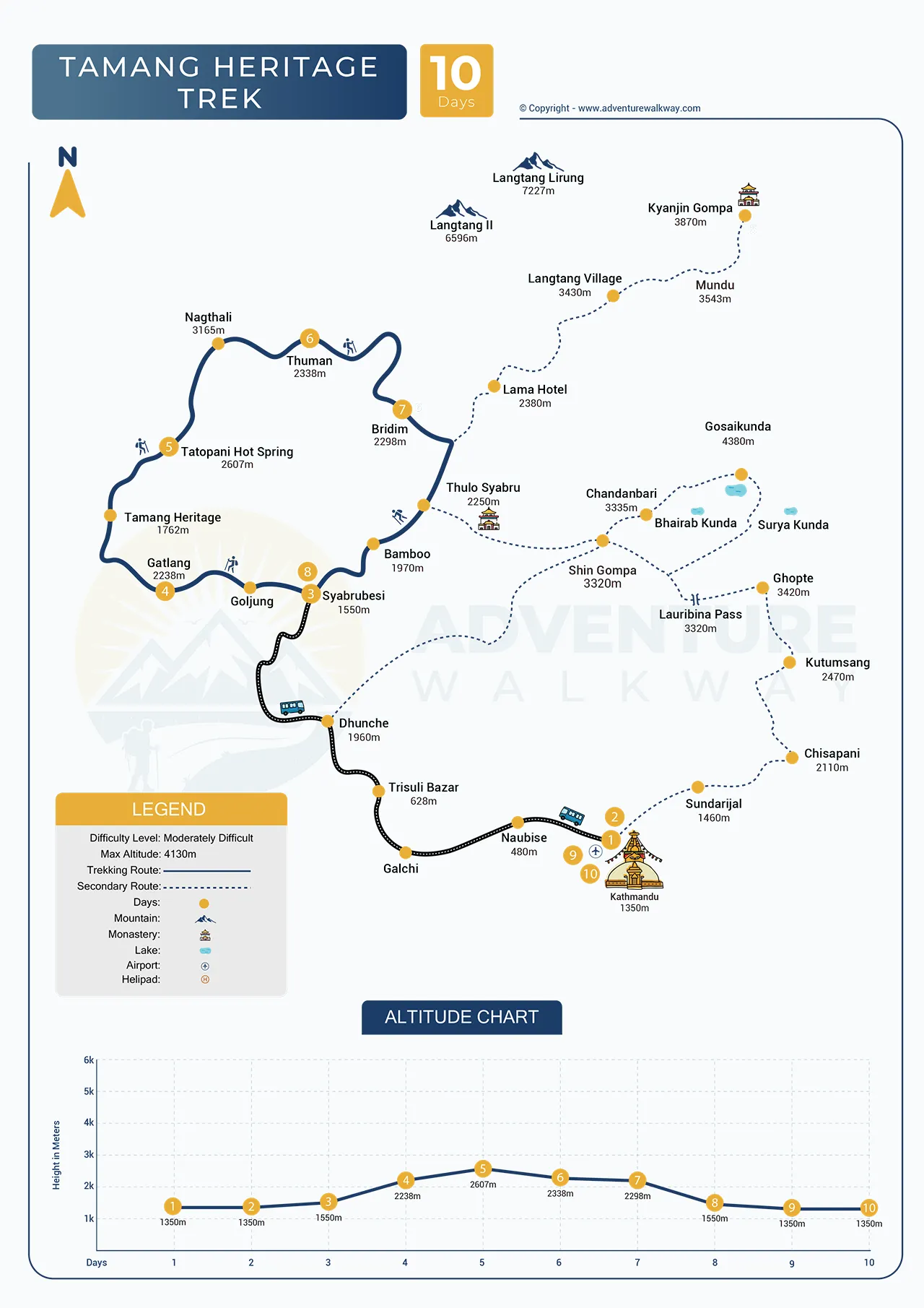
Trip Information
Main Attractions of the Tamang Heritage Trail Trek
Tamang Heritage Trail Trek is one of the iconic trail destinations in Nepal, where local and foreign people can explore the Langtang region and be up close and personal with the Tamang cultures and lifestyles. Let’s take a look at some of the major attractions of the Tamang Heritage Trail Trek.
Tatopani
Tatopani is another trendy but small village in the Sindhupalchok district. It is one of the smallest villages in Nepal, as it had only a population of over 600 people during the 1991 census. It is one of the major attractions for trekkers en route to their Tamang Heritage Trail trek. To reach Tatopani, you must descend through another small village in Gatlang.
The path is filled with several iconic vantage points from where you can see different kinds of mountains as you pass through mani walls, Chortens, and woodlands before reaching the Chilime Village. You will also get to the lake made by the Chilime Hydropower Dam. The name Tatopani is kept because of the natural hot spring located in the area where you can rest and relax. You will stay overnight at Tatopani.
Dukchu Gomba Monasteries
Highly respected Tibetan Lama Chukla Khnaga Gomba and Guru Rinpoche have announced that they have chosen the sacred site to be the famous monastery named Dukchu Gomba Monastery. A sacred site is a place of honour, culture, and tradition for the people of the Tamang culture, who have spent most of their lives around the area.
The monasteries are peaceful and significant, and from the site’s peak, you can see the highest point in the Langtang Himal, Langtang Lirung. Dukchu Gomba Monastery symbolises peace and harmony for the Tamang people living proud lives and not being touched by Western culture or tradition.
Nagthali Danda
Nagthali Danda is another major attraction that trekkers can visit and explore during their Tamang Heritage Trail Trek. The place lies at an altitude of 3165m and is the tallest point in the whole trek. After walking through Tatopani, you will see the rich, beautiful, but small village of Briddhim, from where you will start hiking for a few hours till you reach a fantastic place to have lunch among the view of the tallest mountains in the area, like Ganesh Himal, Tibetan Himal, Langtang Lirung, and the the the Shishapangma. After spending a few hours in Nagthali Danda, you will return to Thuman to continue your Tamang Heritage Trek.
Lama Hotel
Lama Hotel is the final destination of the Tamang Heritage Trail Trek, which is at an altitude of 2460m. You will reach the Lama Hotel on the seventh trek day after descending from Nagthali Dada. Once you head towards Thane and then Briddhim, you will head towards Lama Hotel via the bank of the Bhote Koshi River.
You will see several small villages, barren grasslands, and bamboo and birch groves, and you can also explore the rare wildlife of the area, where you can get the chance to see extremely rare red pandas. After six hours of excursion, you will reach Lama Hotel for dinner and an overnight stay. You will have breakfast the next day before making your back to Syabrubesi.
Cultural Encounters
Deeply immersed in Tamang traditions, influenced by Tibetan ancestry, the Tamang Heritage Trek is where to get to know this group of people. Buddhist chortens, prayer flags, and monasteries that reflect this heritage can be found in villages like Thuman and Bridim. Traditional Tamang dances, folk stories, and even the monks from local gompas are common for trekkers to witness. Others showcase the craftsmanship of the Tamang people in handwoven textiles, wood carvings, and unique architectural styles.
There is a chance to dine with locals who cook meals using only stone cookstoves and organic ingredients. Daily village activities such as herding yaks, harvesting crops, or brewing chhayang (local rice wine) can be participated in by trekkers. The trip strengthens the understanding of and appreciation for the culture, which goes beyond landscapes to the heart of Himalayan heritage.
Food and Accommodation in the Tamang Heritage Trail Trek
Along the Tamang Heritage Trek, teahouses provide facilities for lodging and meals with simple rooms that have shared bathrooms and wooden beds. Accommodations in villages like Gatlang, Tatopani, and Bridim are run by local Tamang families so that trekkers can experience the authentic. Solar charging at some teahouses is available, but charging anything may cost extra. The rooms have basic furnishings, and warm blankets are available at higher altitudes.
Nepali meals are typically Tibetan and traditional dishes like dal bhat (rice and lentils), thukpa (noodle soup), Tibetan bread, and momos (dumplings). Trekkers can also try locally produced yak cheese in Kyanjin Gompa. On long trekking days, it is advised to carry high-energy snacks. Drinking from filtered or boiled water is necessary, as bottled water is often costly and bad for the environment.
Foods and Drinks
There are many options for food and drinks during your trek, but you have to be careful to choose only the best hygienic foods and beverages. You must eat food that is filled with protein and carbohydrates. You must avoid any foods that can make you heavy or dehydrated you. The foods that you will eat are divided into three meals.
Breakfast
Breakfast is the earliest meal you will eat, early in the morning, before starting your trek. Some options included in the breakfast meals are eggs, bacon, chapati, cornflakes, French toast with butter, cheese, jam, local tsampa, bread, porridge, and hot tea or coffee.
Lunch
Lunch is another food option that you will get during the trek. After having breakfast, you will trek for a few hours before stopping for lunch. There are several options for lunch, which are Tibetan Bread, Salad Pizza, Snacks, Momo, Steaks, and Desserts. Macaroni dishes, Tenduk Spaghetti Noodles, Sherpa Stew, Potatoes, Vegetables, Dhal, Bhat, Sandwiches, Tarkari, and others. These are some of the healthy and hygienic options for lunch. Among them, you also have options to eat meat, fish, and alcohol; however, we recommend you only stick to healthy foods and avoid alcohol to not dehydration.
Dinner
Dinner is the final meal option of the day. You will have your dinner after reaching the destination of the trekking day. Just like breakfast and lunches, there are several options for dinner, such as Dhal, Bhat, Snacks, Korean Ramen, Tarkari, Potato items, Steaks Vegetable Curry, Tibetan Bread, Noodles, Thukpa, Sandwiches, Hard Drinks, Pasta, Momo, Desserts, Tenduk Spaghetti, Macaroni, Various Soups, Steaks, Vegetable and Salad Pizza.
As you can see, there are a variety of options to choose from, and among them, there is the option to select from local Nepali dishes to a variety of Western and Asian dishes too.
Accommodation Options during the Tamang Heritage Trail Trek
The accommodation facilities are one of the most accessible and comfortable services you will receive during this excursion. The accommodation facilities are basic and standard, as you will stay in three-star hotels in the city and teahouses in the remote area of the trek.
The tree houses in the lower altitude have small but wide rooms with three to four bedrooms with comfortable and fluffy blankets, pillows, mattresses, and attached bathrooms. You will also have an attached sink and WIFI facility available. In the higher altitude teahouses, the rooms are generally made for sharing, so you might have to share with other trekkers, but if you are alone and female, you will have access to a private room without extra expenses.
Which places are included in the Tamang Heritage Trail?
Tamang Heritage Trail is among Nepal’s trendy trekking destinations as it leads to Nepal’s most beautiful Langtang Valley. The treks take you to famous places like Gatlang, Goljung, Syabrubesti, Buddhism, Chilime, Dhunche, Thuman, Brimdhing, and Nagthali. These beautiful places are also collectively called the Tamang Heritage Trail as they signify the importance of Tamang culture, tradition, and rituals.
Ever since the colonisation, these places have remained unique destinations for anyone who wants to visit and learn about the Tamang Culture, which is the reason the Nepal Tourism Board has granted permission for the Tamang Heritage Trail trek, where people will get to know more about the new places and new culture more often.
Best Time for Tamang Heritage Trek
The best months to take the Tamang Heritage Trek are the spring months (March to May) and the autumn months (September to November), when the weather is stable and the views of the mountains are clearest. In spring, the rhododendrons begin to bloom, the foliage greens up, and the temperatures stay mild, making for easy and scenic hiking. The crisp air, dry conditions, and unimpeded Himalayan canvas make Autumn the ideal season for photography.
However, winter (December to February) brings snow on the trails and few open teahouses; monsoon (June to August) means muddy paths and lots of rain, which can also cause landslides. Trekking in the recommended seasons also provides for better visibility, safer trails, and a more rewarding cultural experience, since Tamang villages are full of festivals during these months.
Difficulty of the Trek
The Tamang Heritage Trek is considered a moderate trek, and so, trekkers with basic fitness levels can take up this trek. Hiking distance varies from 5–7 hours a day with constant ascents and descents around Tatopani and Thuman. The trek isn’t overly high in altitude, but there are a couple of steep climbs along the way.
It has well-marked trails but there is some rough terrain and river crossings. Elevations are below 2,700m, and altitude sickness is rare, but acclimatisation is still necessary. If prepared properly, this trek offers a rewarding cultural and scenic experience suitable for those looking for an alpine adventure combined with time spent with Nepalese locals in the traditional Himalayan way.
Fitness & Training for the Trek
Cardio fitness, leg strength, and stamina are needed to prepare for the Tamang Heritage Trek. If you can, hike on uneven ground to train; work to slowly build your endurance through brisk walking, cycling, and running on slopes. Use squats, lunges, and core exercises to get the muscles stronger and use balance on steep paths.
As the trek is one constant ascent and descent, daily walks with a weighted backpack help recreate conditions. Breathing exercises will help with oxygen efficiency at higher altitudes, and staying hydrated and eating appropriately help your overall resilience. Before you start, it is sensible to get used to the level of demand of Himalayan trekking by doing short treks above 2,500m if at all possible.
Permits Required for the Trek
Langtang National Park Entry Permit and a TIMS (Trekkers’ Information Management System) Card are required to trek through the Tamang Heritage Trail. While foreigners are charged NPR 3,000 for a National Park Permit and NPR 2,000 for a TIMS card (independent trekkies or trekkers with a guide), SAARC nationals don’t need to pay for a National Park Permit but have to pay NPR 1,500 (independent trekkies or trekkers with a guide), and NPR 1,000 for a TIMS card for independent trekkies or trekkers with guide.
Both permits can be obtained in Kathmandu (Tourism Board Office) and Dhunche. These fees go towards park maintenance, local infrastructure, and promoting sustainable tourism, thus making for responsible trekking in the Langtang region.
Packing Essentials
A safe and comfortable trek depends on how you pack. Sturdy hiking boots, moisture-wicking clothes, and a waterproof jacket for any unpredictable weather are essential trekking gear. Thermal inner layers, fleece jacket,s and a down jacket are key—layering is often the key away from the snow.
It gets quite cold at night and so requires a four-season sleeping bag. UV protection sunglasses and gloves protect from the sun’s rays, while trekking poles aid with balance on uneven pathways. If you will be in villages with little to no electricity, a headlamp is useful, with spare batteries.
Bring altitude sickness medication, first-aid kits, and electrolyte sachets for health. Nuts, chocolate, and protein bars make high-energy snacks for the long trekking days. Remember permits, ID copies to tag along with that, and a detailed map for easy navigation through Langtang’s Tamang villages.
Altitude Sickness and Prevention
Attitude sickness can happen at heights greater than 2,500m, though you are unlikely to see severe cases on the Tamang Heritage Trek. The most common symptoms are headaches, nausea, dizziness, loss of appetite, and shortness of breath. Dehydration, rapid ascents, and exhaustion increase risks.
Acclimatize gradually to prevent altitude sickness, keep hydrated, and avoid alcohol and smoking. Trekking at a steady pace, having the odd rest day, and eating high energy meals allows the body to get used to adapting. In case the symptoms deteriorate, it is necessary to descend immediately. Diamox (altitude medicine) can be of help, but it needs to be taken on medical advice. Trekkers are guided by people trained in altitude sickness management to avoid potential mishaps. Complications can be prevented if early signs are recognized and dealt with quickly.
Responsible Tourism
Responsible trekking protects local ecosystems and communities. Always avoid littering any rubbish and take all of your waste back out with you. You can also use reusable water bottles to reduce plastic waste. Support village economies by choosing locally owned teahouses and opting for ethical trekking companies that treat guides and porters fairly.
Show respect for local customs by requesting permission to take photographs of people, dressing modestly, and learning basic Tamang greetings. And to prevent environmental degradation, stick to the trails. Help with conservation efforts so the Langtang region’s natural beauty can be enjoyed by many generations down the road.
Travel Insurance
When you trek, you need comprehensive travel insurance that includes medical emergencies, high–altitude evacuation, and trip cancellation. In Nepal, helicopter rescues can cost thousands of dollars, so insurance has to cover evacuation above 2,500m. They should also cover lost baggage, accidental injuries, and delays due to weather.
For Langtang’s remote trekking routes, always double-check that your insurance provider covers it. Make sure to carry physical and digital copies of your insurance details in the case of an emergency. With reliable travel insurance, trekkers can relax about finances and medical concerns, secure in the peace of mind that coverage will help them should anything happen.
Frequently Asked Questions
You need two permits: Langtang National Park Permit and TIMS.
ATMs are only available in major cities like Kathmandu, but when you reach a secluded area, there is no option for an ATM.
In the city area, you can get mineral and sparkling water, but in the higher altitudes, you will have access to mineral water and, upon request, can get hot water.
The highest elevation we reach is Nagthali Danda, which has an altitude of over 3165 meters.
Yes, any beginner with decent physical stamina and a hygienic body can complete the Tamang Heritage Trek.
Yes, with basic fitness and preparation.
Possible, but sightings are rare near Gatlang and Tatopani.
Trip Reviews
Price starts
US$ 795
We offer group discounts
- 1 - 1 personUS$ 895
- 2 - 5 personUS$ 795
- 6 over 9999 US$ 695
Total Cost:
US$ 895
Need Help? Ask Questions
Dipendra Dhakal
+977-9851093471 (Whatsapp)